• All About Juno
  • Bad Girl: The Power of the Lilith Archetype
  • Charts for Articles in past issues of ECLIPSE
  • Excerpt from ‘The Moon & You: Interpreting the Moon in the Natal Chart’
  • How Do We Reconcile Placidus with Whole Sign, and Still Love Ourselves in the Morning?
  • On Eclipses
  • Services
  • Terms of Use
  • Zeus, or, What a Man Gotta Do

Julie Demboski's ASTROLOGY

~ Addressing the Individual Experience Within the Universal Truth

Julie Demboski's ASTROLOGY

Category Archives: The Social System

The Return of the Goddess

12 Sunday Jun 2022

Posted by juliedemboski in astrology, goddess energy, Something For You, Spiritual Considerations, The Social System, The Word Image

≈ 11 Comments

Tags

goddess energy, The Word Image

Goddess Bhadrakali Worshipped by the Gods from a tantric Devi series, Artist Unkinown, 12th century {{PD}}

This is a reprint from ECLIPSE, slightly modified, and has already appeared here at the blog under a different title–but I do think the ideas bear repeating. Looking for the Full Moon report? See it here.

There’s been lots of talk these days about the return of the goddess–but I don’t think the goddess was ever gone. Seeing it as a disappearance/ re-appearance is seeing it through patriarchal eyes: women have always been, so goddess has always been. A patriarchal society is a Doing-oriented society, one that recognizes and values action, while (typically) disparaging its opposite, the essence of female energy: the receptive, the accepting, the open, the Being-oriented. Goddess energy is female energy, and functions by filling space and time with its very existence; it is vital simply by being, whereas male energy only exists when it is in motion, closed, targeted, inflicting itself on others or the environment. It’s a disparity that many have difficulty grasping, and this is chiefly because we have been indoctrinated with a bias for movement, action, ‘results’, and a sense of accomplishment that relies on seeing change, rather than feeling it. The goddess can sit perfectly still and sense the inevitable processes of growth and decay all around her–she is in fact aware that she is part of this cycle–while those invested in the god-like animus credit only the effects the hands or mind have on the landscape.

In modern Western society we’ve been conditioned to see worth and even virtue in emulating male doing energy, no matter one’s role. We applaud activity, even when it’s purpose or value is questionable, and we see this ‘busy’ attitude reflected in phrases like ‘Protestant work ethic’, ‘Yankee ingenuity’, ‘make hay while the sun shines’, and so on. This is not to say that effort is not important, but that it is only one side of an equation; to celebrate doing and accomplishing without also celebrating the contemplation, depth, communion, feeling, sensitivity, and intuition that can not only shape and guide effort but make sure efforts are effective, is to make action a god, and to cast being as a meaningless state that offers nothing to our advancement–and of course, nothing could be further from the truth.

We tend to have disdain (or at least, less regard) for the kind of contemplative or menial or repetitive tasks that act as a meditation and are much more a being state than a doing one; we may label these ‘women’s work’ (oh, the derogatory tone with which this is spoken!) and see them as beneath us, since they don’t include the slap-dash of going from A to B–but that would miss the point. No one thought to ask the grasshopper why he fiddled while the ants worked–but no grasshopper lives through the winter; it would’ve been a waste of his time to put away food for days he wouldn’t see. (And if we want to get technical about it, the ants would awaken from a torpor to begin their work and replenish their colony before much had grown or bloomed out in the world, so they did need a storehouse). In nature there is balance and reason, room for both god and goddess energy, a different set of rhymes and rhythms that apply to each creature–and we should keep that in mind when judging what’s appropriate or ‘right’, useful and useless.


‘Jupiter in the Guise of Diana Seducing Callisto’ By Gerrit van Honthorst {{PD}}

The picture above is a testament to recognition within the patriarchal structure of Western society that sometimes receptivity is needed in order to gain what is wanted. There’s irony in a doing-dominant entity choosing to enact the anima in order to get something, which getting is in itself a highly animus thing, the kind of goal the doing energy is consistently targeting and pursuing. In the painting Zeus (Jupiter) has apparently learned that abduction and rape don’t win him any friends; instead he transforms into the goddess of the Moon and the Hunt, Diana, and lures Callisto with the Moon’s sensitivity, responsiveness, and ability to reflect back to others what they ‘shine’ with–and yet, in choosing Diana’s form, he’s choosing the most animus-like of the goddesses, in terms of her Self-expression through hunting and pursuit. Empathy requires the surrender of boundaries to the point that one Being can feel the other Being, complete, which the male-oriented cannot do without putting aside the continual, outward thrust of energy that is the normal modus operandi for them.

Even in Zeus’ choice, though, the usefulness of the receptive, Being stance is denigrated, as it’s seen as a tactic with which to accomplish  a goal, rather than as a state of Being just as valid and as dynamic in its own way as any action. With Zeus it’s a means to an end, and so falls in a long line of actions meant to fulfill the animus aim; if it were a true goddess energy, the communion would be without boundaries, and no specific outcome would be on the agenda–being would be enough. If quantum mechanics are correct and the butterfly’s movement is enough to topple a civilization as the shift ripples through matter and time, then the even more subtle shifts in consciousness, attitude, belief, and the effects of both prayer and love are felt as strongly as anything built, accomplished, or acquired. So next time you see a woman sitting with eyes closed, or standing quietly out in the grass, or strolling along with no destination in mind, or rocking a child, you’ll know just how busy, how important what she’s doing, really is.

Your word image is a pair of things: the mention of Karma addressed in or in the name of works of Art, and a key that suddenly appears on the floor at your feet. As they’ve come up at the same time, I can’t help but think they’re linked, each describing a part of what needs our attention. The key came first. Of course, there’s the key, the ‘at your feet’ part telling me it’s laid out before me, presented even, no searching required. The image seems to say: Here’s what you need, that vital thing that will open it all up, let you in to where you want to go. I kept seeing references to Karma related to Art that made me wonder what was in the Collective air that was influencing Artists. Too often I feel that Karma is mis-represented as something outside ourselves, when in my view it’s really just the accumulated energy of our own choices and actions, bouncing off the energy of everything else in existence–that is, it’s not something weighing and judging you, out to get you, to ‘balance’ the Universe, it’s just you, meeting your own energy in another form. So, that would suggest that the key we need to acknowledge, pick up, and use, the use of which will be entirely to our benefit, presents in a situation that’s nothing more than our own accumulated efforts and attitudes, bringing about particular results and circumstances. My thought is: you’ll know this ‘Karmic’ thing, and what it means, when you see it–and you’ll also know, it’s the key you’ve been looking for.
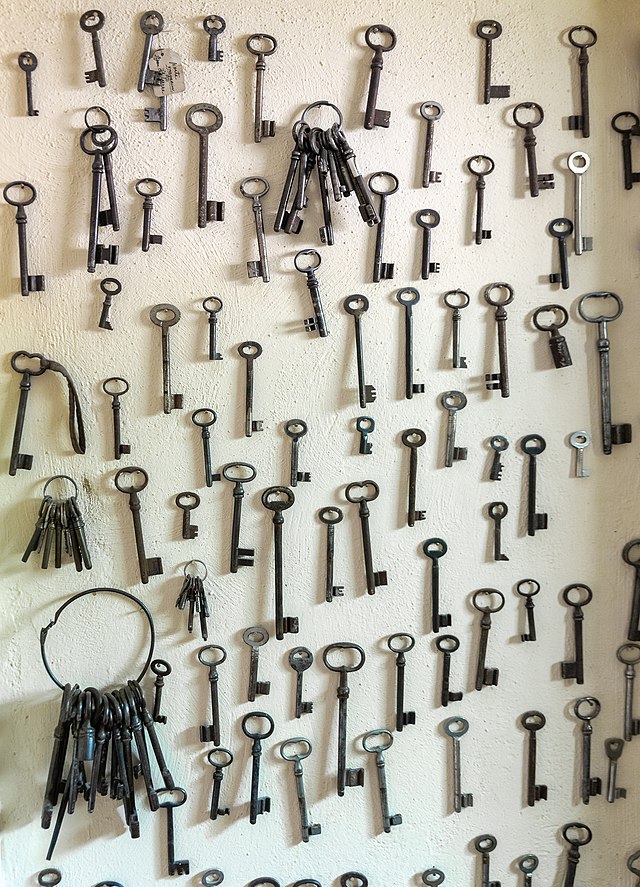
Friedrich Haag

Creative Commons Attribution-Share Alike 4.0

Rate this:

Share this:

  • Click to share on Facebook (Opens in new window) Facebook
Like Loading...

From the Movies, With Love

13 Sunday Feb 2022

Posted by juliedemboski in astrology, Media, The Social System, Valentine Thoughts, Venus

≈ 1 Comment

Tags

Valentine Recommendations, Venus in Action

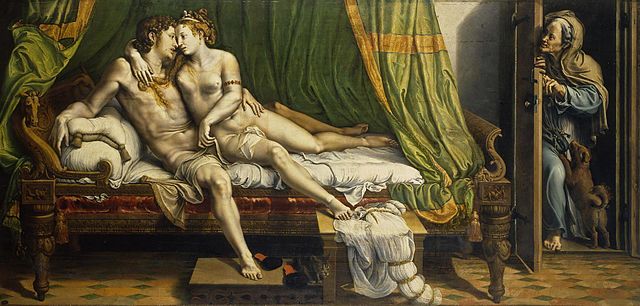
Here we see a pair of lovers respecting the old Hayes Code, which required one foot on the floor if a movie showed two people in bed. ‘The Lovers’ By Giulio Romano c1525 {{PD}}

Tongue-in-cheek suggestions for Valentine viewing, offered with potential after-viewing coping remedies, from an article in ECLIPSE, with editing and additions. Seems appropriate, as we have Venus and Mars together in Capricorn (looking at the nitty-gritty of relationships, wanting to know the limits, the boundaries, and to feel secure), the Moon in Cancer stepping hard on our feelings as of this writing, and Luna opposing Pluto and a 29 degree Mercury, suggesting we’re desperate to get our heads straight about how we feel. It may seem we’re both required to celebrate relationships and given no way to express any feelings that aren’t 100% positive–and that’s not healthy. I think it helps to inspect others’ relationships, and movies let us do just that–here are some of my favorites. Happy Valentine’s Day!

                Blue Valentine  (2010) Saturn, in the person of Ryan Gosling, is happy with his life–he goes to work, is a husband and father, and has no aspirations, wanting only to continue the status quo; Venus, played by Michelle Williams, is into pleasure, but also a bit of a seeker, in worldly terms, and what ultimately leads to the painful disintegration of their marriage is the way in which he fails to suffer from the same gnawing discontent she does. At one point they go away to a theme motel; their choices are ‘Cupid’s Cove’ or the ‘Future Room’–I can’t help but think things would’ve gone better if they’d opted out of spending time in the cold, tinny blue light that exposed the future they would never have. Watch something like The Proposal (2009), to revive your faith in relationships, ’cause Ryan Reynolds can fix anything, or get outside in the sunshine or use your SAD light. And maybe some cookies.

                Stealing Heaven  (1988) It’s been years since I saw this movie, but it’s a hard core love story–who else but those irrevocably drawn together would defy the system (one where an academic was expected to be celibate, and where females weren’t supposed to be educated) and end up beaten, bruised, and in a nunnery? The movie details the story of real-life Medieval lovers Héloïse and Abélard, as they struggle with questions and conventions of the day, including whether it’s more noble to serve God with chastity, or to celebrate God with earthly pleasures (Jupiter wants it all, doesn’t he?) Two aspirin, washed down with a martini in celebration of the fact that human castration isn’t part of the college curriculum nowadays.

                The Wings of the Dove (1997) A true love triangle where no one gets what they want. We see a pair of lovers (Helena Bonham Carter and Linus Roache) who are stymied by a mutual lack of money in their desire to be together and yet not incur the wrath of her well-to-do aunt (the icy Charlotte Rampling). Enter “the wealthiest orphan in the world” (Alison Elliot) who immediately befriends the pair and persuades them to come to Venice–and a plan, misshapen and virtually unspoken until late in the game, materializes, since the orphan *cough* *cough* is on her way out. Staged with some of the most sumptuous Nouveau costuming I’ve ever seen, and then there’s Venice–what more could you want? Only 1 glass of wine, lingered over while gazing sadly at the sunset. With a special thought given for all those for whom love (Venus) is, one way or another, spoiled by the subject of money (Venus). From the novel by Henry James.

The House of Mirth  (2000) Ladies! There comes a point when pride must go by the wayside, and we must settle–but that couldn’t be what Edith Wharton meant, could it? The story of Lily Bart is one that emphasizes how important it is to understand the social milieu in which you move and, most especially, your place in it. Lily doesn’t; one seemingly small disaster after another ensues, creating a slow motion fiasco. Jupiter, then, in the form of society, is the villain here. Lily, sure she’s a never-fading Venus, shows in her own soft way many of the goddess’s worst qualities, incarnate. With Gillian Anderson excellent in the title role. What would Lily do, in the present day? With any luck, she might not take herself so seriously. This story is a lesson in not seeing one’s physical Beingness as a commodity, given in exchange for the social position and monetary sustenance we think we deserve–invariably, we’ll get the measure wrong. With a suggestion to sort one’s Love inclinations from one’s material needs, for our own safety. Three Motrin, two glasses of wine, and a search on Facebook for old boyfriends

Melancholia (2011) Much of the movie centers on a wedding, and it’s difficult to understand why the bride (Kirsten Dunst) is so on-again, off-again in her attitude–until the bigger picture comes into focus. Relationship dynamics are all-consuming for the short-sighted and the blithely ignorant, and the viewer comes to see that the bride’s melancholy springs from her canary-in-the-coal-mine sensibilities: she knows what’s coming, even as she doesn’t know what’s coming, and acts accordingly. Sumptuously shot, with some amazing sequences, from the ever-upsetting Lars Von Trier. If you’d like to see more of his takes on relationships, may I recommend the harrowing AntiChrist, and the thoroughly dispiriting Breaking the Waves, or the amazing Midsommar (2019) by another upbeat guy, Ari Aster. Post-viewing for any of these movies: sort through your affairs, get right with your God, and then take a long nap.

The Heat (2013) Not a romance but a babemance, and an example of how even women who are nothing alike will have more in common with each other than with any man, if they can only see it. An argument for being Self-possessed and supportive, even as you refuse to wait for a sense of completion through a romantic partner. You’re all right just as you are, ladies (and gents). Recommended: Girls’ Night Out, or order a pizza, to share or just for you, or do whatever you want–it’s your life.

Rate this:

Share this:

  • Click to share on Facebook (Opens in new window) Facebook
Like Loading...

Goddess Energy

04 Friday May 2018

Posted by juliedemboski in Books, gods and goddesses, The Social System

≈ 3 Comments

Tags

'The Venus Collection', Being vs. Doing, goddess energy

‘La Nymphe Callisto, séduite par Jupiter sous les traits de Diane’ 1759 By François Boucher

This is something included in another new book I’m working on, ‘The Venus Collection’, featuring new and previously available articles of mine on the goddess of Love. Have a great weekend, everyone!

There’s been lots of talk these days about the return of the goddess–but I don’t think the goddess was ever gone. Seeing it as a disappearance/ re-appearance is seeing it through patriarchal eyes: women have always been, so goddess has always been. A patriarchal society is a doing-oriented society, one that recognizes and values action, while (typically) disparaging its opposite, the essence of female energy: the receptive, the accepting, the open, the Being-oriented. Goddess energy is female energy, and functions by filling space and time with its very existence; it is vital simply by being, whereas male energy only exists when it is in motion, closed, targeted, inflicting itself on others or the environment. It’s a disparity that many have difficulty grasping, and this is chiefly because we have been indoctrinated with a bias for movement, action, ‘results’, and a sense of accomplishment that relies on seeing change, rather than feeling it. The goddess can sit perfectly still and sense the inevitable processes of growth and decay all around her–she is in fact aware that she is part of this cycle–while those invested in the god-like animus credit only the effects the hands or mind have on the landscape.

In modern Western society we’ve been conditioned to see worth and even virtue in emulating male doing energy, no matter one’s role. We applaud activity, even when it’s purpose or value is questionable, and we see this ‘busy’ attitude reflected in phrases like ‘Protestant work ethic’, ‘Yankee ingenuity’, ‘make hay while the sun shines’, and so on. This is not to say that effort is not important, but that it is only one side of an equation; to celebrate doing and accomplishing without also celebrating the contemplation, depth, communion, feeling, sensitivity, and intuition that can not only shape and guide effort but make sure efforts are effective, is to make action a god, and to cast being as a meaningless state that offers nothing to our advancement–and of course, nothing could be further from the truth.

We tend to have disdain (or at least, less regard) for the kind of contemplative or menial or repetitive tasks that act as a meditation and are much more a being state than a doing one. We may label these ‘women’s work’ (oh, the derogatory tone with which this is spoken!) and see them as beneath us, since they don’t include the slap-dash of going from A to B–but that would miss the point. No one thought to ask the grasshopper why he fiddled while the ants worked–but no grasshopper lives through the winter; it would’ve been a waste of his time to put away food for days he wouldn’t see. (And if we want to get technical about it, the ants would awaken from a torpor to begin their work and replenish their colony before much had grown or bloomed out in the world, so they did need a storehouse). In nature there is balance and reason, room for both god and goddess energy, a different set of rhymes and rhythms that apply to each creature–and we should keep that in mind when judging what’s appropriate or ‘right’, useful and useless.

Within the patriarchal structure of Western society, sometimes receptivity is needed in order to gain what is wanted; there’s an irony in a doing-dominant entity choosing to enact the anima in order to gain something, which getting is in itself a highly animus thing, the kind of goal the doing energy is consistently targeting and pursuing. In the painting ‘Jupiter and Callisto’ by Boucher, Zeus has apparently learned that abduction and rape don’t win him any friends; instead he transforms into the goddess of the Moon and the Hunt, Diana, and lures Callisto with the Moon’s sensitivity, responsiveness, and ability to reflect back to others what they ‘shine’ with–and yet, in choosing Diana’s form, he’s choosing the most animus-like of the goddesses, in terms of her Self-expression through hunting and pursuit.

Empathy requires the surrender of boundaries to the point that one Being can feel the other Being, complete, which the male-oriented cannot do without putting aside the continual, outward thrust of energy that is for them the normal modus operandi. Even in Zeus’ choice, though, the usefulness of the receptive, being stance is denigrated, as it’s seen as a tactic with which to accomplish a goal, rather than as a state of being just as valid and dynamic in its own way as any action. With Zeus it’s a means to an end, and so falls in a long line of actions meant to fulfill the animus aim; if it were a true goddess energy, the communion would be without boundaries, and no specific outcome would be on the agenda–being would be enough.

If quantum mechanics are correct and the butterfly’s movement is enough to topple a civilization as the shift ripples through matter and time, then the even more subtle shifts in consciousness, attitude, belief, and the effects of both prayer and love are felt as strongly as anything built, accomplished, or acquired. So next time you see a woman sitting with eyes closed, or standing quietly out in the grass, or strolling along with no destination in mind, or rocking a child, you’ll know just how busy, how important what she’s doing, really is.

And if you’re curious about Zeus in the astrological chart, my theories are here. Donate  —  Read  —  Enjoy!

Rate this:

Share this:

  • Click to share on Facebook (Opens in new window) Facebook
Like Loading...

Blog Stats

  • 2,223,489 hits

Pages

  • All About Juno
  • Bad Girl: The Power of the Lilith Archetype
  • Charts for Articles in past issues of ECLIPSE
  • Excerpt from ‘The Moon & You: Interpreting the Moon in the Natal Chart’
  • How Do We Reconcile Placidus with Whole Sign, and Still Love Ourselves in the Morning?
  • On Eclipses
  • Services
  • Terms of Use
  • Zeus, or, What a Man Gotta Do

Donate

Recent Comments

  • musicbuttery09e983d9fe on Full Moon 3 January 2026 Anticipation
  • Анна Цветкова on New Moon 19 December 2025 It’s In Our Hands
  • juliedemboski on Water Water Everywhere
  • Jude Cowell on Water Water Everywhere
  • eleusisd on Water Water Everywhere

Enter your email address to follow this blog and receive notifications of new posts by email.

Join 1,386 other subscribers
Follow Julie Demboski's ASTROLOGY on WordPress.com

Search

Pages

  • All About Juno
  • Bad Girl: The Power of the Lilith Archetype
  • Charts for Articles in past issues of ECLIPSE
  • Excerpt from ‘The Moon & You: Interpreting the Moon in the Natal Chart’
  • How Do We Reconcile Placidus with Whole Sign, and Still Love Ourselves in the Morning?
  • On Eclipses
  • Services
  • Terms of Use
  • Zeus, or, What a Man Gotta Do

Create a free website or blog at WordPress.com.

Privacy & Cookies: This site uses cookies. By continuing to use this website, you agree to their use.
To find out more, including how to control cookies, see here: Cookie Policy
  • Subscribe Subscribed
    • Julie Demboski's ASTROLOGY
    • Join 1,386 other subscribers
    • Already have a WordPress.com account? Log in now.
    • Julie Demboski's ASTROLOGY
    • Subscribe Subscribed
    • Sign up
    • Log in
    • Report this content
    • View site in Reader
    • Manage subscriptions
    • Collapse this bar
 

Loading Comments...
 

You must be logged in to post a comment.

    %d