
• All About Juno
  • Bad Girl: The Power of the Lilith Archetype
  • Charts for Articles in past issues of ECLIPSE
  • Excerpt from ‘The Moon & You: Interpreting the Moon in the Natal Chart’
  • How Do We Reconcile Placidus with Whole Sign, and Still Love Ourselves in the Morning?
  • On Eclipses
  • Services
  • Terms of Use
  • Zeus, or, What a Man Gotta Do

Julie Demboski's ASTROLOGY

~ Addressing the Individual Experience Within the Universal Truth

Julie Demboski's ASTROLOGY

Category Archives: Astrology of Careers Vocations and Callings

Fly Girls: Earhart, Coleman, and Co.

23 Friday Oct 2009

Posted by juliedemboski in aspects and placements, astrology, Astrology of Careers Vocations and Callings

≈ 6 Comments

Tags

Amelia Earhart, Bessie Coleman, Hilary Swank, real life astrology

Swank as Earhart

Swank as Earhart

In honor of the new Hilary Swank biopic on Amelia Earhart (and the controversy surrounding its star, who has recently been criticized for sleeping nude and allowing her boyfriend’s young son to see her this way), let’s look at the chart of the pioneering aviatrix and of her rival, another female pilot who could’ve easily outshone Amelia, if not for the efforts of Earhart’s husband–more on that later; first, we’ll peek at Swank’s chart, and see if there’s anything in the natal chart that might indicate the chance of winning two Oscars before age 29, as well as the affinity for sleeping naked. We have no time of birth, but we do have a date and place for Swank (30 July 1974  No Time Known  Lincoln NE USA). Without angles we’re frustrated in connecting energies to the public image, but we are able to see the Leo Sun trine Sag Neptune, a creative and extremely outgoing Soul urge; add the Moon and Pallas each at 29 degrees (Sag and Cap, respectively) and we have the emotional necessity to express the skills–this really is the signature of someone who in just being alive will be compelled to express express express the creative and imaginative nature–and it’s the kind of energy that draws the attention (and admiration, via the skills) of others–and their projections, as well, through the strong Neptune/ Sun contact–really perfect for a performer. No angles takes away a main timing element, but we do notice that the natal Saturn, Mercury, Venus conjunction did, by Solar Arc, contact the Sun at the ages of 18 (Mercury), 25 (Saturn–the year of her win for ‘Boys Don’t Cry’–see? Saturn brings good things to those who work hard!) and 26 (Venus–the point when the paycheck likely soared), so it’s not hard to image major accolades coming in early adulthood to this Leo lady. As to the stir over sleeping habits, Hilary’s Vesta/ Uranus conjunction says that the individuality and uniqueness (as well as the urge to be different) of the Self is sacred to her, and the exact Chiron/ Uranus opposition suggests that the expression of one’s freedom could be a way of refusing to succumb to wounds to the Self-esteem or fears (and that there’s not an ounce of lasciviousness in her penchant for nudity). Not at all a surprise, then, that this Leo should be chosen to portray another Leo, aviatrix Amelia Earhart (24 July 1897  11:30 PM  Atchison KS USA) http://en.wikipedia.org/wiki/Amelia_earhart. Rather than concentrate on what every schoolchild already knows about ‘Lady Lindy,’ as she was called (after Charles Lindburgh, another ambitious pilot), I’d like to point out two lesser known facets of her life, the first being her involvement with nursing and social work.
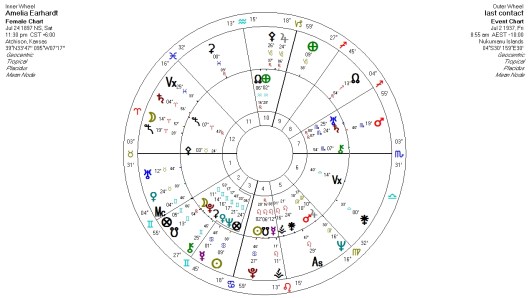
Amelia trained as a nurse in response to the flu pandemic of 1918, and at her Saturn Return, after she’d already earned her pilot’s license and garnered a reputation as an aviator, she began work with Dennison House, a resource for disadvantaged families. We see this in the natal Saturn/ Uranus conjunction in the 7th (the need to do something concrete, progressive, socially relevant, for others); possibly, too, in the Moon/ Pluto conjunction in the 2nd, suggesting deep empathy out of personal experience, and the Grand Square of Sun/ Earth axis and Pallas/ Chiron opposition (this latter across the 12th/7th axis), showing a serious need both to show the skills for personal fullfillment and glory, and to heal wounds, both personal and of the Collective (in this instance, Chiron taking on transpersonal expression, attempting to alleviate some of the darker suffering of others–Scorpionic Chiron in the 7th).

Amelia on the wing, George on the ground

Amelia on the wing, George on the ground

The other thing about Amelia we might not be aware of is that she wasn’t the only famous aviatrix of the time (notably Beryl Markham–read about her interesting life http://en.wikipedia.org/wiki/Beryl_Markham and Bessie Coleman, about whom we’ll talk in a moment), but it may have seemed that way to many in the US, as Amelia’s marriage to George Putnam of Putnam publishing fame in 1931 put her firmly in the limelight–not because her exploits were more impressive than anyone else’s, but because Putnam not only published and promoted her book, ‘The Fun of It’ very successfully, he knew how to work that era’s publicity machine as few others did. The reality was that though others were known for feats just as exciting as Amelia’s at the time, we chiefly have her disappearance, while trying to complete an around the world flight with co-pilot Fred Noonan, as well as her husband’s tireless pre- and post-disappearance promotion, to thank for her status as legend.

The last radio contact with Earhart and Noonan occurred at 8:55 AM local time near Nukumanu Island on the way to Howland Island in the Central Pacific Ocean. If we look at the chart for the time of last contact as it relates to the natal chart, we don’t see a lot of bang-up contact, and to me this suggests that Earhart likely landed her plane on an atoll, rather than plummeting to her death in the ocean (and this is supported by the spotting of old wreckage by satellite in 2001). What we do see hints at some possibilities: the 29 degree Ascendant suggests that at this point, her fate was sealed–whatever was wrong had already cascaded into a determined course; natal chart ruler Venus in transit shows a semi-sextile to the natal Part of Fortune (dubbed the Part of Misfortune by Richard Houck, who found it involved often at points of fate determining events), square to Juno, and opposition to Saturn and Uranus, signalling a moment when the individual is challenged in many significant ways; T Neptune square N Ceres (with T Ceres and Juno at 00 degrees, calling for adaptablility to the ‘new’ vibe), suggesting perhaps that Earhart’s natural sense of earth and sky, so vital to a flyer, may have been confused, or that she may not have recognized a ‘natural’ problem of some kind; and the transiting Moon sextiled natal Pluto–an emotionally charged glimpse into the abyss, certainly echoing the natal situation (of the loaded 2nd House, containing Moon, Pluto, Ceres, Neptune, Venus, Part of Fortune).  Another note on the natal chart: the Mars/ Jupiter conjunction in the 5th, endowing the individual with the romantic view of exploration and pioneering efforts, and connecting the ego and animus to these, with Jupiter ruling the 8th and 9th, bringing in the need to garner others’ support and to explore what’s ‘foreign’–certainly a signature for Earhart’s efforts as a flyer.

Bessie and her plane

Bessie and her plane

Another female flyer, Bessie Coleman, gave Amelia a run for her money–if Amelia hadn’t been married to Putnam, it might have been Bessie who would be the stronger presence in the national consciousness–especially considering that Coleman was the first licensed Black pilot, male or female, in the world. ‘Queen Bess’ (26 January 1892  no time known  Atlanta TX USA) was inspired by returning WWI pilots to take to the air–and when she couldn’t get anyone to teach her how to fly in the US, she went to Europe, where she studied with some of the best flyers in the world. Coleman performed around the country as a barnstormer, a flyer who astounds crowds with daring feats and acrobatics; she became a celebrity, known for her ability and willingness to perform the most difficult stunts. Unfortunately, Bessie didn’t live long enough to fulfill her dream, which was to establish a school for young people of color who wished to fly. It was in 1926, while up with her mechanic and publicity manager at the stick, that Bessie was thrown, unsecured, from the open cockpit to her death. A (literal) wrench in the gears caused the controls to jam and the plane to plow into the ground–and in many ways this rings true to the chart, where great talent and drive is shown as being challenged at every turn (the many squares).

We see Bessie’s spirit loud and clear in the natal chart. A Sag Moon shows the need to reach out, explore, and the willingness to go far to fulfill the emotional needs; Uranus forms a T-square with the Sun/ Earth axis, suggesting that dynamism of the individuality acted to energize (and also present challenges to) the Soul expression and identity and material situations; Vesta is quincunx Saturn–this struck me as an expression of the need, or even insistence, of ‘getting off the ground’–quite literally, in this case! The Nodes create a T-square with Pallas apex, implying that intelligence ran the destiny–but also presented plenty of challenges to moving forward successfully (such as through the desire to do something she at first was unable to find co-operation or support for); Sedna quincunx Uranus, epitomizing perhaps the form many problems took, but also an ‘engine’ that helped drive accomplishment, in that she may not have seen how her own rebelliousness to the system, individuality, innovative spirit, and intelligence served to both hinder and propel her accomplishments; Venus trine Uranus=treasuring the uniqueness of Self, something any groundbreaker needs; and I see bravery in the ‘chain reaction’ conjunction of Venus (at 7 Pisces), then successively Ceres, Jupiter, and finally Juno (at 22 Pisces)–this combo epitomizes a very strong, capable, and confident individual with both the ability to empower herself and an ultimate faith in the Universe (Pisces) that supports her independent path. Read about ‘Queen Bess’ here http://en.wikipedia.org/wiki/Bessie_Coleman and here www.bessiecoleman

Here’s an excellent update on Amelia’s status http://ameliaearhart.com/news/2009/10/earharts-final-resting-place-believed-found/, with thanks to Jude Cowell’s http://www.starsoverwashington.com/ for pointing the way

Rate this:

Share this:

  • Click to share on Facebook (Opens in new window) Facebook
Like Loading...

What You’re Asking: 12th House Suns, Juno/ Venus Synastry, and, Are Scorpio Moons Misanthropic?

19 Saturday Sep 2009

Posted by juliedemboski in 12th House, 5th House, astrology, Astrology of Careers Vocations and Callings, Juno, Moon, relationship astrology, Sun, Venus

≈ 10 Comments

Tags

5th House, Juno square Venus, relationship astrology, Sun in 12th House, The Divine Spark

We’ve got a lot of ground to cover; let’s get started with a couple of topics, rather than questions:

5th House and employment astro

When I saw this as a search combo I wondered what led someone to link these together; was it an idea that creativity has something to do with finding a job, or perhaps that they were looking for a job that features creativity? Many people make the mistake of believing that a strong (much occupied, holding the Sun, Moon, or Ascendant ruler) 5th House or transits to the 5th promise a career in the Arts–and though someone with a strong 5th House may indeed find a profession of a traditional creative nature, I see the 5th House as actually signifying one’s store of intangible creative energy, a spark much more potent and broad than is the intent to make Art (though this can certainly be the urge behind it), a life energy that must come out somewhere in one’s circumstances and activities. It’s this same energy that fuels romance, and the conception of a child, both topics also located here (and think of how we tend to see each as coming just a little bit from out of the blue–this is the unconscious organizing and drawing to us that reflects the nature of our 5th house energy), and my theory is that this energy will find a way to express; if we don’t use that creative energy consciously, it leaks out through contacts to the 5th, showing up as action in other life areas. (I once wrote an article on this very subject, the emphasis being on the way the energy tends to express through the mechanism of the unconscious, and the oh-so-helpful magazine editor went through and removed the ‘un’ from every mention of consciousness, thus effectively neutering the meaning of the piece. I had the distinct feeling she didn’t actually grasp my point.) In terms of employment, there are other items we would inspect in the natal chart first, but the 5th can offer clues as to the kind of energy that may be pushing pushing on the unconscious, and that can serve us well, professionally and in life, if channeled, and harnessed to our Will.

Sun in the 12th House

This is a Sun location that really baffles people, especially early on in their study of astrology. It’s tough to define as a placement because the House itself is hard to explain, but we can think of Sun in the 12th this way: the experiences of those with a 12th House Sun will feel ‘once removed’ from the flow of life. By this I mean, the individual will thrive in private–this doesn’t mean he or she won’t be well-known or popular, but instead that the identity development and Soul expression will take place within, and much of this will occur in the subconscious and/ or in large, Cosmic experiences (such as happen in meditations or dreams) that are impossible to share. This can make for a rich imagination and a profound connection to the Universe, as well as an ability to empathize to a depth no other Sun placement can; it also makes for some frustration in communications (though if the individual can turn to images they can communicate directly to others’ Souls). Often, these people will find themselves working behind the scenes, or in a capacity of support for others, or that, even if they gain fame, their attention will remain largely on their inner vision. It’s a unique placement in the way it brings the internal world above the horizon of the chart and links it so directly to the Collective energy, and those with a 12th House Sun have the unusual opportunity to live quite successfully with one figurative foot in the World and one foot planted firmly in the vastness of the Universe.

More on 12th House Suns here https://juliedemboski.wordpress.com/2009/04/21/what-youre-asking-composites-political-suns-and-venus-venus-venus/

Juno square Venus synastry

We have four possibilities here, and each one is significantly different in terms of meaning–why? Because it’s all-important what the sex of each individual is in interpreting this combo. We’ll go one at a time: male Juno square female Venus= dynamic and possibly very promising in a relationship, as we see the male idea of who he wants as a partner contact the female’s ideal of herself as a woman. There could be some basic conflict (the square), but this puts the placements (likely) in the same modality, and if so a harmony can be worked out that can include the spark that comes from just the right amount of friction. female Juno square male Venus= here we have the female’s concept of Self-empowerment squaring off against a man’s aesthetic nature, anima, and asset/ values picture, likely creating a perpetual problem over what receives priority in the relationship, conflicts in spending and values, and these will be felt by the female as undermining her sense of Self and her ability to affect things–not a good combo. male Juno square male Venus= with a same sex male couple the split of animus and anima energies becomes key to understanding effects: if the person with Venus has assumed slightly more anima, then this will read very much like male/Juno female/Venus, above; if it’s the Venus of the animus dominant individual, then we may see a clash over values and relationship standards that could be in conflict with the Juno male’s idea of good partnership. With two females sharing this synastric aspect, we see something intensely competitive, as the two women work out a clash over feelings of empowerment (for one) and the sense of female identity (for the other).

I connected spiritually during sex with

That’s all there was–but there sure are a lot of ways to finish that sentence, aren’t there?

Now, on to questions:

Why do passive-aggressive men sulk?

Because they’re passive-aggressive! Next! No, really, sulking is a passive-aggressive act–no one bothers to sulk when they’re alone, do they? It’s a surface-passive demand for attention that has very aggressive roots. Remember, passive-aggression is both angry and an attempt to manipulate–it’s as if the individual refuses to see themselves as angry, or refuses to acknowledge their own anger and their own wants–instead they combine the two and expect others to jump. The answer? Ignore him. This will eventually infuriate him enough that he’ll actually act, which is something he wants to avoid, because the one thing passive-aggressive people want to do is avoid responsibility. For anything. Ever. They see claiming actions, desires, or even thoughts as an opportunity for others to blame them–and Mr. Passive-A likely grew up in a blame culture. So, while ignoring him, also provide a blame-free environment into which he might, someday, wish to emerge, and if the relationship can survive his not-so-subtle sabotage, he might one fine day lay down his blame stick, take your hand, and actually tell you what he wants to do after dinner.

More on sulking men here http://askjulie.wordpress.com/2009/04/20/sulking-across-the-zodiac-men-and-mood/

How to know if an Aquarius man is taken with you?

This can be tricky, as an Aquarius man, though typically a bit on the cool side, loves the clinical nature of an experiment–and what is a better human experiment than flirting mildly even when he’s unavailable? With this guy, you may need to take a direct approach (especially because withdrawing in order to see if he pursues won’t work–even if he is interested, as he may not notice a growing distance between you!) Asking him if he’s interested is one way to go, but more effective (and less damning, as you won’t look like you’ve been sitting around wondering) is, the next time he makes a remark along these lines, you should turn, look directly at him, and say, “What exactly do you mean by that?” He probably won’t balk at having to explain himself, and you’ll have the advantage of hearing firsthand precisely what he was intending to convey. Mystery solved! Warning: this method does not work with any other sign, with the possible exception of Capricorn.

How long till a man realizes he’s in love?

Unfortunately, a man may not realize he’s actually in love until he’s faced with losing you–it seems it often takes a little scare, a reminder that time marches on, and that he’s mortal and you may be ready to stamp your relationship potential with an expiration date, before he admits to himself that he cares. I’m not advocating the time-worn ‘make him jealous’ idea; instead, you may need to think of it this way: men are hunters by hormones and instincts, and you are the hunted (at least in their symbolic vernacular). The hunter will realize you’re escaping when he sees a flash of your lovely, slender hindquarters (relax, I’m thinking of a deer!) as you bound away, innocently off to graze elsewhere (and, he’ll naturally think, be ogled by other hunters). If he’s truly interested, it will spur him to take aim and pull the trigger (stay calm, symbols, symbols, that’s all they are!)  And if he doesn’t, if he’s willing to let you move off to greener pastures . . . then you’ve found out he wasn’t in love, after all.

Is Scorpio Moon misanthropic?

Of course not! What Scorpio Moon hater told you Scorpio Moons hate people? Not only is a single placement unable to delineate such a trait, it would take quite a pile-up of negative inclinations to safely declare someone a misanthrope using only the natal chart. Scorpio Moons can seem a little hatey to those of us who like things psychotically cheerful 24/7–but that’s more a failure of perception on the observer’s part than an indication of a true dislike of humanity by Scorp.

Lastly, and encompassing one of the major questions we will ever face–

Why can’t we see our divinity?

The short answer is, because we don’t accept the entirety of ourselves as we exist in the moment, and it’s impossible to accept as divine that which we perceive to be flawed. Now, some of us will see this question and confuse seeing the divine within with calling ourselves ‘God.’ That is not what’s happening here; we are instead challenged to recognize that we are made of Creator-stuff (for what creation does not carry the shape, form, and essence of its creator?) and that means that we are, indeed, modeled on the divine, and out of divine-stuff–and so it’s up to us to accept ourselves, imperfect as we may feel we are, as innately divine, and thus to love ourselves, and to accept our perfection and our flaws, which are in their own way their own perfection–we just don’t see the wholeness, the beauty of it, yet.

Rate this:

Share this:

  • Click to share on Facebook (Opens in new window) Facebook
Like Loading...

Jupiter and Spirit Pt.2: A Life Example

14 Monday Sep 2009

Posted by juliedemboski in astrology, Astrology of Careers Vocations and Callings, natal placement

≈ 11 Comments

Tags

Bernie Siegel, careers vocations and callings, health, real life astrology

When we look for Jupiter activity as part of the life purpose, we may tend to dismiss it as more of a role designation than anything else: we see it as strong in educators, the clergy, publishing and broadcasting, those concerned with religion, those involved with travel or foreign lands in some way, or with those linked to Jupiter prominence by Gauquelin’s now legendary study, to include politicians, those with career military involvement, and playwrights–at least, that’s the conventional theory. But I find it much more strongly indicative of a strength of spirit, one that signifies a Soul-need to expand outward, to connect with others, and this need shows up in all walks of life (though Gauquelin’s study did not connect Jupiter to physicians–in fact he showed a Mars prominence for them, at least in terms of placement in the energized sectors surrounding the angles)–yet our example is a well-known oncologist whose seminal work has changed attitudes and treatment for millions of patients and the attitudes of health professionals, and in this way it’s pointed out to us that the spiritually oriented impulse to connect with others overrides every other interest and function, and typically works in concert with other life callings.

Surgeon and cancer specialist Bernie Siegel (14 October 1932  10:00 AM  Brooklyn  NY USA) helped revolutionize the way both patients and health care professionals look at the disease process and the meaning of it as an experience, one that can promote spiritual and emotional healing no matter the physical outcome–and yet we now may forget that there was a time when the mind/ body/ spirit connection was not only not acknowledged, it wasn’t even recognized as existing by the vast majority of individuals, and was a particularly unacceptable idea within the medical community. Despite advances in mental health methodologies, and the promotion of psychotherapy as an increasingly more interactive means of exploring mental process, we were still, well into the 70s, warned by the medical establishment that physical disease had origins only within the physical world; to suggest to one’s physician that emotional ills might be connected to physical ones immediately earned one a label as less-than-rational, and to imply that a spiritual dis-ease could be at the root of things . . . one could be stamped ‘delusional’ and dismissed (and for a woman this kind of labeling could be truly dangerous, as in the male-dominated world of medicine the tendency afterward was often for dismissal of reported symptoms, as well).

In the late 70s and early 80s, Dr. Siegel formulated ideas about the mind/ spirit/ body interaction based on his own observations in treating cancer patients, and formed the first ECap group (Exceptional Cancer Patients), based on the idea that those who survived medical therapies and went into remission showed some distinct characteristics: a generally optimistic orientation to life (and typically an early programmed belief in their own toughness or that they are a survivor no matter what), a real desire to live life (rather than a desire not to die), and a belief that the medicine offered actually helped their condition (and Dr. Siegel points out in one of his books that if you read the protocols on a chemo package you see mention only of the destructive things this product will do to one’s body, and nothing about healing or helping).

Dr. Siegel pioneered the use of art and imagery in healing; specifically, by studying patients and their drawings he found a way into the subconscious, to see what the individual really believed about his or her illness and the effectiveness of treatment–as well he encouraged patients to use imagery in conjunction with medical treatments, believing that this linking of physical and mental intents toward healing vastly improved results.

When we look at Dr. Siegel’s natal chart, we see some factors that illustrate his life focus and his inclinations very well. The most immediately striking feature may be the Cardinal Grand Square involving the Libra Sun in the 10th (the Self must shine publicly and in relation to others), the Pluto/ Vertex conjunction in Cancer in the 8th (dealing with and empathizing with the darkest experiences of others, handling destructive forces of others, is a fated involvement–Vertex as a point of Fate), an exact conjunction of the Moon, Uranus, and the Earth in Aries in the 4th (the Self carries emotional groundedness and innovative and intellectual ability, some of which may spring from the family of origin–and this is verified in Dr. Siegel’s stories of the positive survivorship mentality instilled in him by his relatives), and Ceres in Capricorn in the 2nd (a serious, fact-based understanding of and command of nature and negotiation as a personal asset). The configuration promises that when one is activated all are activated, and that the inherent tension among the factors spurs the individual to action (Cardinal placements).

So how does Jupiter as a significator of the spirit figure in to this dynamic life picture? Contact is made through a trine of Ceres to Jupiter, which sits in the 9th (in this case, taking an educational function for expression), and conjunct the South Node (past experiences come forward to aid the present), Neptune (in this instance, Art, imagination, imagery), and Venus, Sun ruler (values, relationships, love and caring). Here, co-operation between Ceres’ energies and Jupiterian ones may signify that spirit acts as a bridge between the functions of the values and creative imagination and the life function in teaching and guiding others, just as Ceres acted as the bridge between the upper World and the Underworld in negotiating the circumstances of her daughter’s marriage to Pluto (and when we note Pluto’s position in the Grand Square it’s not a stretch to see how Dr. Siegel may act the part of bridge almost literally for his patients, as he has a clear understanding of and ability to negotiate the Plutonian journeys of those he treats).

His Pluto is also involved with a Fist of God configuration with Ascendant apex, the sesquiquadrates to Pluto on the one hand and Earth/ Uranus/ Moon on the other. This lends a strength, insistence, and dynamism to the expression of all related energies through the personality, and perhaps gives the remarkable ‘bedside manner’ and ability to both empathize with and instill confidence in those works with.

In Siegel’s classic book  Love, Medicine, and Miracles he quotes Jungian psychotherapist Dr. Susan Bach, who created one of the first effective and consistent methods for interpreting the contents of patient’s drawings for medical use:

The study of such spontaneous material could give us a glimpse into the psyche-soma relation comprehended as the oldest and best married couple on this earth . . .

Sound like anyone we know? Jupiter, in his role as supreme god was married to Juno, his beloved and yet much disrespected wife, and together they ruled all the other gods (energies), but in Siegel’s chart they have an uneasy relationship, the kind that keeps the individual busy attempting to reconcile the disparate goals and needs. Juno is involved in a Grand Trine with the old man Saturn and Chiron (in the 6th, a House prominently linked to health work), and this suggests nothing so much as the signature of a healer, someone empowered to muster Chirotic energies in the physical world–and this contacts Jupiter via his sesquiquadrate to Saturn, a combo that implies spirit is perpetually in adjustment to the realities of any situation, an attitude that when well-handled, as it is in Dr. Siegel’s case, brings leaps forward in the chosen life arena.Bernie Siegel natal chart

Rate this:

Share this:

  • Click to share on Facebook (Opens in new window) Facebook
Like Loading...
Newer posts →

Blog Stats

  • 2,223,424 hits

Pages

  • All About Juno
  • Bad Girl: The Power of the Lilith Archetype
  • Charts for Articles in past issues of ECLIPSE
  • Excerpt from ‘The Moon & You: Interpreting the Moon in the Natal Chart’
  • How Do We Reconcile Placidus with Whole Sign, and Still Love Ourselves in the Morning?
  • On Eclipses
  • Services
  • Terms of Use
  • Zeus, or, What a Man Gotta Do

Donate

Recent Comments

  • musicbuttery09e983d9fe on Full Moon 3 January 2026 Anticipation
  • Анна Цветкова on New Moon 19 December 2025 It’s In Our Hands
  • juliedemboski on Water Water Everywhere
  • Jude Cowell on Water Water Everywhere
  • eleusisd on Water Water Everywhere

Enter your email address to follow this blog and receive notifications of new posts by email.

Join 1,386 other subscribers
Follow Julie Demboski's ASTROLOGY on WordPress.com

Search

Pages

  • All About Juno
  • Bad Girl: The Power of the Lilith Archetype
  • Charts for Articles in past issues of ECLIPSE
  • Excerpt from ‘The Moon & You: Interpreting the Moon in the Natal Chart’
  • How Do We Reconcile Placidus with Whole Sign, and Still Love Ourselves in the Morning?
  • On Eclipses
  • Services
  • Terms of Use
  • Zeus, or, What a Man Gotta Do

Create a free website or blog at WordPress.com.

Privacy & Cookies: This site uses cookies. By continuing to use this website, you agree to their use.
To find out more, including how to control cookies, see here: Cookie Policy
  • Subscribe Subscribed
    • Julie Demboski's ASTROLOGY
    • Join 1,386 other subscribers
    • Already have a WordPress.com account? Log in now.
    • Julie Demboski's ASTROLOGY
    • Subscribe Subscribed
    • Sign up
    • Log in
    • Report this content
    • View site in Reader
    • Manage subscriptions
    • Collapse this bar
 

Loading Comments...
 

You must be logged in to post a comment.

    %d