A Good Day To . . . 16 April 2020

Tags

, ,

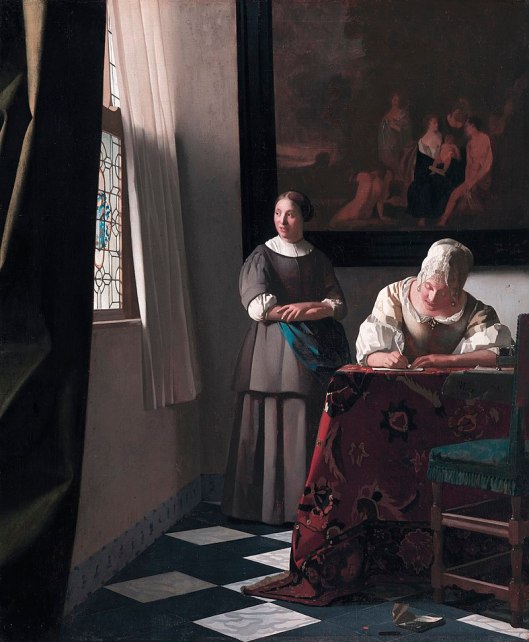
‘Woman Writing a Letter, with Her Maid’ By Johannes Vermeer c1670 {{PD}}

The 16th is a Good Day To . . . ask ourselves: What must we change about our stated values to make them align with our actions (because our actions reflect our true beliefs)? Aligning what we do and are with what we think we do and are will have massive benefits, if we have the courage to act on it. And second, what habit or choice made in the past can we resurrect in service to our own empowerment and/ or earning ability? Those may seem at first glance to be big, open-ended questions, but in reality they are quite specific; each of them is asking for one thing, the first for personal honesty, the second for you to reach back in memory to bring forward a practice, habit, or exercise that expressed a part of your essence. Right now we all need both a frank assessment of our values, and to recycle and bring back to life something that manifests a vital portion of the spirit (and the key to knowing what this is will be found in what once brought you genuine joy). Again, we’re asked to look into and think about the abyss–and this time when we look away, we come back to daily life refreshed in a Soul-deep connection to our most authentic identity.

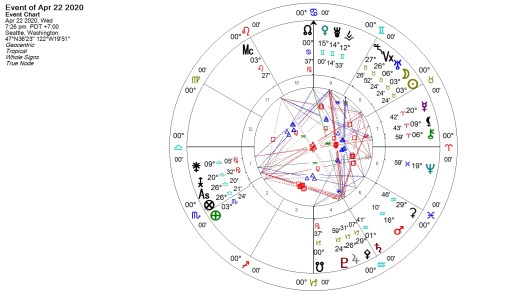
A Good Day To . . . is based on the aspects perfecting on each day, Pacific time.

Want to know more about your purpose and roles in life?

A Good Day To . . . 15 April 2020

Tags

, ,

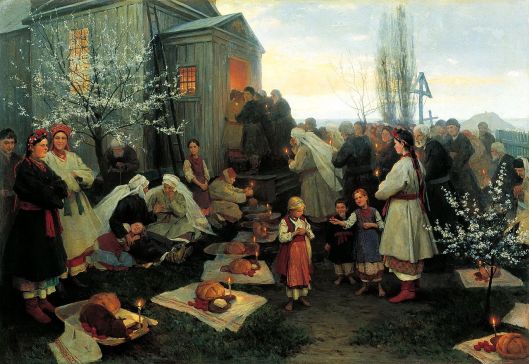
‘Easter morning’ By Mykola Pymonenko 1891 {{PD}}

The 15th is a Good Day To . . . see and acknowledge the dark underbelly of Love and Finance, specifically as it applies to your ideas of your own power, authority, and reach. I’m seeing this as something where we must accept both the darkness and the light we get from relationships, or the positives and negatives that weigh into one’s assessment of a job, career, or financial arrangement. The scenario we’re faced with may point out in stark terms how we tend to minimize or ignore the compromises we make in order to maintain a status quo. But, though it’s possible you might be moved to change things, the intent is more to draw your attention to the need to discontinue sugar-coating an area of your life that’s developing a sticky-sweet crust that will eventually become super-unappealing, and that may already have put you in an awkward (or at least not beneficial) position within the social sphere, or that has kept you from growing and becoming ‘more’.

A Good Day To . . . is based on the aspects perfecting on each day, Pacific time.

A Good Day To . . . 14 April 2020

Tags

, ,

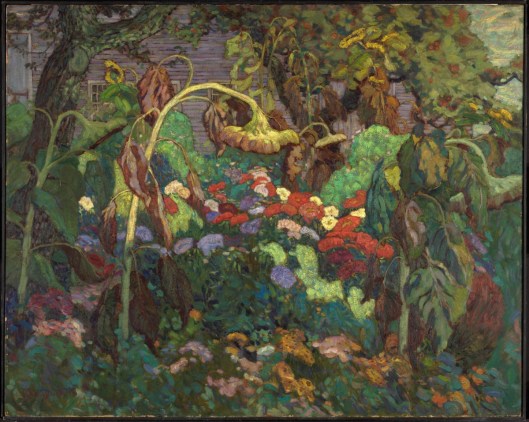
‘The Tangled Garden’ By J. E. H. MacDonald 1916 {{PD}}

The 14th is a Good Day To . . . count on yourself. It’s no time to look to others to bolster your position–they’ve got troubles of their own. You may feel uncertain of instincts and intuition–that simply serves as a warning, ‘You’re afraid, or you’re hurt, and you can’t let that run the show.’ That said, you gain in three separate ways: by sticking with values, no matter what; by refusing to tangle with the powers-that-be–you’ll lose; and by concentrating on the several ways you are truly gifted–doing what only you can do benefits you tremendously.

An interesting note: Venus conjoins Vesta today. Could we get a bigger endorsement of the benefits of staying home? Do it, so we can beat this thing.

A Good Day To . . . is based on the aspects perfecting on each day, Pacific time.

A Good Day To . . . 13 April 2020

Tags

, ,

‘Grand Canyon of the Yellowstone’ By Thomas Moran 1872 {{PD}}

The 13th is a Good Day To . . . act on inspiration and the creative urge, but not without refusing to abandon highest values. That means don’t do anything you might otherwise find unacceptable just because circumstances suggest it might offer ‘a new way’ or garner you ‘creative credit’. There’s much to be gained by ‘facing the music’ in financial circumstances or within relationships, so don’t hesitate to peer into the abyss–and be ready to stand your ground when it looks back at you.

A Good Day To . . . is based on the aspects perfecting on each day, Pacific time.

A Good Day To . . . 12 April 2020

Tags

, ,

CC BY 4.0

The 12th is a Good Day To . . . be aware of the many forms of balance we’re called upon to achieve/ maintain. Awareness will both enhance health and supercharge instincts and intuition. We may be called upon to face a certain darkness, an unpleasant facet of reality, and if we do, we lay a strong foundation that keeps us from being deceived, as well as guaranteeing that certain ‘skeletons in the closet’ won’t ever trouble us again.

A Good Day To . . . is based on the aspects perfecting on each day, Pacific time.

See the recent Full Moon in Libra here–

Time: We Are The River Running Through It

Tags

,

By Harald Sohlberg 1906 {{PD}}

The following is an article, slightly modified, that first appeared in an October 2012 issue of ECLIPSE, for your weekend reading pleasure. Please note, the article uses Placidus charts.

There are a great many ways to think of time; all of them suggest connection among what we call the past, the present, and what is to come. It’s our nature to measure time from our own vantage point within it, and that means we do see it, whether we believe intellectually that it is or not, as a progression. Though one part is gone, seemingly unalterable from where we stand now, and the circumstances of one part have not yet coalesced around us, we somehow have difficulty both recognizing that the present is the one period we can affect without question, and that certain events in the present and the future actually arose in the choices of the past (and this is setting aside the fact that the ‘now’ that is as you read this sentence is not the same ‘now’ that existed when you read the first sentence of this article, an awareness of a kind of ‘micro-flow’).

Initially we tend to see ourselves as immersed in time, carried along on its currents, with a flow that comes out of the past and stretches out into our future. It’s only human to pretend at being mystified by this flow and the events it brings, to see what happens as beyond our control–for then who can blame us for what comes to pass? If we see things as truly random, the question of karma, of ultimate balance and reason existing whether we can see it or not, becomes invalid in our own minds; with this attitude we will see only chaos, and probably spend our lives struggling to affect what results.

Once we reach a point where we are willing to accept responsibility for our choices without excuses, to see the Universe as always, consistently causal (and that this is so whether we are privy to the causal chain of events, or the organizing energy behind it, or not), we open up a whole new way of seeing the world and the things that happen around and to us. We recognize that we are not floating on that river of time, but are part of it–we are running through it. We take our place as a component of the Universe, not as a segregated, helpless traveler within it–and it’s not a big leap from there to begin contemplating time, and how we might define it, affect it, even control it.

There is a time component inherent to those energies in astrology that define life urges. It seems that when we feel that spark of movement, we see the energy as dimensional, as containing one or more concepts of time. For instance, Saturn is the traditional indicator of time, standing for the actual process of what we perceive as time’s passage, for maturing, building, aging–it manages to symbolize all linear time–even our use of a baby for the New Year and an old man for the end of that year speaks of the Saturnian experience of time.

‘Head of a Bearded Old Man (Saturn)’ 1516 By Albrecht Dürer {{PD}}

But Saturn also tells of non-change, the antithesis of time itself; Saturn can signify the static, the permanent, the unchangeable. Saturn is where we are firmly rooted in reality (and sometimes fear), where the past is set in stone, and where the past and present are all there is. Saturn is usually our go-to reference astrologically for time, along with the Moon. Lunar influences are ever-changing, malleable and fluid, and so ‘fill in’ those ‘missing’ parts to the Saturnian definition of time. The emotional component of the Moon’s perceptual lens renders the passage of time subjective, and so difficult to measure with Lunar consciousness, which is so unlike the steady tick of the Saturnian timepiece. In every way that Saturn suggests forever, Luna implies an illumination of the moment, here and gone, ever-shifting.

But we have other astrological signifiers of the concept of time, and it’s important we’re aware of them, as they can, mentally and spiritually (and who’s to say not also physically?) describe our experience of the time we occupy within the Cosmos. They can become ‘where we are’ just as certainly as we can be contained within the more familiar Saturnian bounds of time. Time, from the astrological perspective, need not always be considered linear–though certainly the cycles and procession of planetary movement from our vantage here on Earth, the very stuff we examine to know the meaning behind it, implies that within the limited framework of our human brains, a linear approach helps us make sense of it all, at least for purposes of organization and understanding. Still, awareness of other perceptual possibilities shows us the dimensionality of the Universe, and gives us hints of ‘What If?’ always an exciting prospect.

The planet Neptune may be the most obvious astrological body with the potential to affect our perceptions of time. With this outer behemoth we see that to be in a Neptunian state, lost in creativity or confusion, brings our awareness of the passage of time to a standstill–not like the Saturnian permanence, but in a way that seems to remove us from the linear flow–we lose a sense of time passing, or even existing, when we are immersed in Neptune; we are in what is known to some as ‘Dream Time’. The House where our natal Neptune sits, as well as the House(s) with Pisces on the cusp, might be the places we are most likely to be able to slip outside the stream of time, to gain a sense of suspension that does not capture us in a single moment (as Saturn does) but that removes the tick of the clock altogether. Here we can apply imagination, and experience matters of the House unfettered by the linear prescription; these are matters where we can lose ourselves, and our Self-consciousness, in such a way that we can connect with both our own purest sense of creativity and with the Collective itself, without boundaries or even the ability to differentiate ourselves from ‘all else’.

For instance, the person with a 12th House Neptune, or Pisces on the cusp of the 12th, may easily ‘lose’ themselves in compassionate service, meditation or spiritual practice, or as a part of a large institution or cause. Mother Teresa (26 August 1910  2:25 PM  Skopje Macedonia) has Neptune in Cancer in the 7th, and Pisces on the 3rd. This suggests an ability to lose herself in caring, not for the Collective, as in the 12th, but for ‘All Others’ as defined by individuals, the human ‘audience’ all around her, with the Pisces cusp placement telling us of her need to communicate the importance of this caring attitude.

‘White Cat and Two Yellow Butterflies’ By Arthur Heyer c1900 {{PD}}

Or, as in the case of Henry David Thoreau, the naturalist and proto-ecology proponent (12 July 1817  9 PM Concord MA USA), we find Neptune and Uranus in Sagittarius in the 10th. That’s like a signature for someone who becomes known for his boundary-less connection to nature and his innovative and pioneering attitude toward it (and interestingly, Thoreau had Ceres, the asteroid of our relationship to nature and our own natural power, in the 12th–Neptune’s ‘natural’ House–trine the North Node, with Pluto at the midpoint–again, a recipe for fine understanding of nature, and the need to transform our attitudes and views toward it, as part of the Path). And, for good measure, he had Pisces intercepted in the 1st, making the ability to lose himself in those Neptunian areas a personal one. Not only does this illustrate our point about Neptune as our place of communion with the Cosmos, it brings forward another point: that our strongest characteristics and qualities are typically found repeatedly in the chart, echoing their importance within the life.

Happiness is like a butterfly: the more you chase it, the more it will elude you. But if you turn your attention to other things, it will come and sit softly on your shoulder.”   Thoreau

With Uranus and Aquarius we find a time-sense of spontaneity, sudden events, immediacy, modernity, and ‘the new’–and in time awareness this translates as being in the moment. We are present in these parts of the chart, and usually highly aware of both our individuality and our place within the group. Artist Salvador Dali (11 May 1904  8:45 AM  Figueras Spain) had Uranus in the 6th and Aquarius on the 8th, suggesting that it was part of his daily routine, his ‘job’, to be unique and highly individual! His ‘uniqueness imperative’ was to be shared with others, and very likely supported by them (8th House)–an important thing for any artist to garner from his or her audience. Still unsurpassed inventor Nikola Tesla (10 July 1856 12 AM Smiljan Croatia) had Aquarius on the 11th–the dream/ goal of invention–in many ways Aquarius on the 11th frames it as the House of the Future, and Aquarian connections to electricity, Higher Thought, and computing seem apt–and Uranus in Taurus in the 1st, suggesting a personal ability to innovate with ‘materials of the Earth’–perhaps a more grounded-seeming energy than we would’ve expected, though not an inappropriate one, as a practical approach is essential to implement those things of the imagination in the material realm. Also of note: his Neptune in Pisces in the 12th, the perfect illustration of one who enjoys a direct creative line to both the Collective and the Universe.

Though Mercury can stand for the minutes or hours on a clock face or in a day, and as well for many other mundane systems accounting for the passage of time, or for the changeability of our direction, literal or figurative (as in the meaning of ‘mercurial’), the planet doesn’t capture a sense of time so much as a measure of it; and the Mercury-encapsulated idea of swiftness emphasizes movement rather than a state of perception (though we could grant Mercury domain over ‘an instant’, if we then didn’t have to define it as a ‘doorstep moment’, of revelation or a turnaround), so that something may change or pass in a Mercurial way, even as it is perceived through a lens of, for instance, Neptune (‘the hour passed in a fog’) or Uranus (‘suddenly I changed my route’ the suddenness of perception being Uranian, the movement–in this case a ‘route’–being Mercurial). Mars, though a proponent of action without reservation, speaks more of a viewpoint than of anything else: ‘I am here, everything else is out there, and I will act upon it’. So oriented is Mars toward movement and activity that he barely takes in surroundings or one’s perceptions relative to time–he is instead so intent on acting that the Mars perceptual lens can be acted upon, just as Mercury’s is, by other, more time-oriented, energies. The same is true of Jupiter; with his orientation toward expansion he pushes out, but does not think of other than efforts in the now, a spreading, sharing, enlarging of what he already is. All these energies are process, rather than time, aligned, placing them firmly in the ‘action’ category. And Venus? She too is in-the-now, the experience of Love, jealousy, envy, or oneness with another through intimacy removing the consciousness from anything other than the current moment. Venus is immersive, in every sense.

We might wonder, then, about Pluto: about his rulership of the Underworld, of what is hidden, kept secret, of what Plutonian lends itself to the idea of interior time, of those things internalized by the Self as making up a cognitive, emotional, and spiritual place populated by the deepest part of us. Our secrets, our most intense and private beliefs, our dark corners, our shame, our wants, our rage, the parts of our beingness that are known only to ourselves, create a personal landscape that is an accumulation of memory, and so an accumulation of consciousness of time. Pluto may represent the closest approximation astrologically to a living aggregation of feeling that makes up who we are–and so is another, very personal, record of the past that still lives within our memory–and so Pluto could be considered to keep the past alive inside the present. Pluto can, though, hold energies that project us into the future; he tells of rage, and lust, and change through destruction or transformation, and all these are like a view of what future will follow from the past–so maybe Pluto is our best indicator of the future, by transit, by Solar Arc, and from received transits.

‘The Bronx River’ By Ernest Lawson c1910 {{PD}}

Pluto, then, may embody us as the river that runs through time. It is created from our past, our present (through desires, anger, projection), and our futures–and I say ‘futures’ as it contains all the possibilities, running the gamut from re-birth to total destruction. Aspects to Pluto may indicate our ‘interior issues’, those things we may be pre-occupied with, in one form or another, until we have adequately plumbed the darkness that surrounds them–and that may take a lifetime.

A Good Day To . . . 11 April 2020

Tags

, ,

Ceres is prominent, right now. ‘Ceres ou l’été’ By Jean-Antoine Watteau 1717-18 {{PD}}

The 11th is a Good Day To . . . consider, face, and deal with questions surrounding your rights and your power expression. You need to know how far you can reach without overextending, and you need to get past some Self-imposed blocks arising from old wounds. Doing this in itself is empowering, and helps each of us answer in real-world terms the problems we currently face in moving forward. Successfully carrying all that’s worthy from the past and translating this into usable energy with which to shape the future is the challenge right now; we meet it with clear, reality-oriented thinking that refuses to shy away from the way things are.

It’s also a good time to examine what you’re ingesting, both in the form of food and mentally/ emotionally. Sensitive reactions to intake of all kinds are a loud-and-clear message that some things must be eliminated or avoided, for optimal health.

A Good Day To . . . is based on the aspects perfecting on each day, Pacific time.

See the recent Full Moon in Libra here–

A Good Day To . . . 8-10 April 2020

Tags

, , ,

‘Triad Brilliant, Passaic River Hills’ By Oscar Bluemner 1932 {{PD}}

The 8th is a Good Day To . . . play around with the (sometimes brilliant) ideas the Full Moon has prompted, and in particular, if you can apply smart action to the current situation, you can enjoy a certain amount of healing and/ or will find where and how you can utilize a ‘gift’ that’s specific to you and your experience.

By the 9th we find we are in the groove, with instincts flowing freely and guiding our efforts and the focus of our attention, and yet, there are some cautions: overdoing or going overboard endangers the careful balance behind the health picture; ambitions either meet resistance (externally) or you find yourself battling within, insisting on a certain course of action when the Universe is trying hard to show you just how the ambition picture in its current form, if realized, will short-change you; and take note of dissonances as you go about your day, as these will show you exactly where and how what you’re considering or attempting violates your highest values. It will likely feel as if there’s no reason not to take that step or do that thing, but that jangly inner warning lets you know that there’s danger ahead if you proceed. So, it’s a day of optimism and progress that requires your attention to and willingness to modify choices so that you don’t hit an unanticipated brick wall down the road.

On the 10th, you remember those changes you were asked to make? Did you make them? Because if you did, action and choice will easily align with values, and so propel efforts forward. The one thing you shouldn’t look for right now is a boost in personal power, or a reward/ pay off–neither is ripe yet, so collecting those fruits now will just give you a tummy ache later (sorry for the fruit metaphor). Expect what happens today to re-orient thinking along more Self-responsible, and more action-centered lines, and be kind to yourself: life is a process, and you’re already at your destination: you have a body, don’t you? So relax, it’s all on track.

And you may want to note that Pluto will retrograde on the 25th. Though normally the apparent turnaround of a heavy like Pluto is felt more as a ‘background shift’, in this case we should take note of the House it’s transiting and the House it rules. We may experience a bit of an earthquake, as this reveals some deterioration or destruction we were unaware of (or at least, we were unaware of the extent of). No need to fear it, just prep now for the change that will, inevitably, come.

A Good Day To . . . is based on the aspects perfecting on each day, Pacific time.

Catch the recent Full Moon in Libra here–

Libra Full Moon 7 April 2020 An Impetus to Action

Tags

, , ,

‘Moonrise’ By George Inness 1887 {{PD}}

Just a few notes about today, to add to the Full Moon influence:

It doesn’t take a genius (or even an astrologer!) to tell you that change, and the need to take action (even if that action is a withholding, a form of ‘sheltering-in-place’, physical, psychic, or otherwise) are the order of the day. The thing is, change is happening and much of it is outside our control; that means that in order to not just cope, but to thrive, we need to exercise as much control within our own purview as we possibly can. Repeatedly, studies have shown that taking even small actions in situations where we are largely helpless can give us a sense of empowerment, and can bolster our immune system as well as our mental and emotional health, and so help us survive–and in this case, the current astrological picture supports this approach whole-heartedly.

Embrace the reality of things (we don’t do ourselves any favors right now living in a fantasy or pretending that we can just go on in the same ways as always), and act based on facts and within the restrictions of the situation–obvious, but easy to forget when anxiety takes over. Focus should be in two areas: making changes to enhance health (obvs!) and listening to the instinctual, the unspoken, and making the effort to read between the lines, figuratively speaking, and then be willing to see the import of what’s not there, not stated, not coming forward. That’s where both information and empowerment on a personal level lie.

Stay safe, have a lovely Full Moon!

A Good Day To . . . 6 April 2020

Tags

, ,

‘Sisters’ By Edouard Vysekal 1922 {{PD}}

The 6th is a Good Day To . . . know that we are once again inspired and brimming with creative energy. This comes directly from clear boundaries (probably drawn yesterday after a less-than-positive experience) and a strong sense of and respect for our own instincts. We admit there are things we don’t know, and we admit that there are things we know without being able to point to any evidence, and this respect for and acceptance of ourselves works some small miracles, healing what needs healing, and reminding us of all the good things the past taught us, gave us, or shaped in us, that we use today.

A Good Day To . . . is based on the aspects perfecting on each day, Pacific time.

See the upcoming Full Moon in Libra here–

Julie Demboski's ASTROLOGY

Addressing the Individual Experience Within the Universal Truth

Skip to content ↓