Your Ascendant Zodiapedia: ‘It’s War, Isn’t It?’ Aries

Tags

,

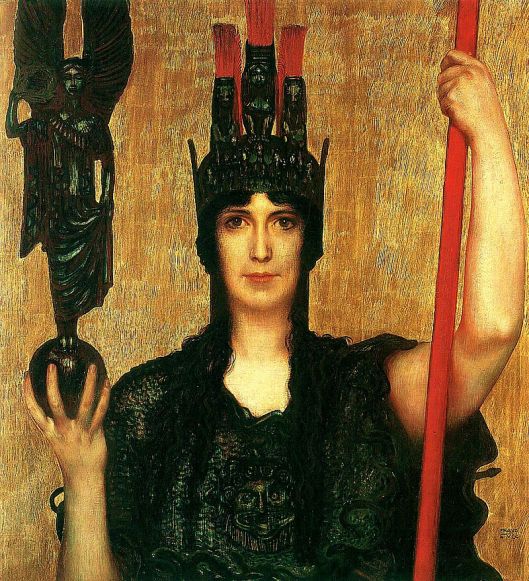
Aries on the Ascendant shares a lot of characteristics with the Warrior Pallas. ‘Pallas Athena’ By Franz von Stuck 1898 {{PD}}

This is the initial installment in a series that appeared previously in ECLIPSE (editing and additions have been made), where we inspect some of the characteristics, assumptions, and impulses with each sign as it captures the Ascendant. This is the symbolic place where we enter the world; the nature of the sign on it suggests both how we meet our environment, and what we believe is necessary to survive in it, and so forms the personality. I try to give a little of both the view from outside (the way others perceive those with the Ascendant in a particular sign) and from the inside (with the individual looking out at the world, and how that Ascendant response may have been shaped). First, Aries on the Ascendant:

Aries is a Warrior spirit, even when the undertaking is domestic, economic, meditative, or pleasurable in nature. Life brings out the ‘Me First!’ competitive spirit of Aries, and he should never be blamed for that. At the same time, one of the things Aries needs to learn is cooperation (a reflection of the opposing sign, Libra). What we see with Aries on the ascending horizon is someone who likely needed to put themselves first in order to survive, or who needed to lead others for the survival of all. Though we may see those circumstances as unlikely in early life, especially the leading of others, all we need think of is a child either left to their own devices to survive day-to-day or one who finds him- or herself in a position to help others survive (I think of a man I knew who, born during the Depression, cooked and cleaned for his three brothers from the age of 5, when his mother was at work in the fields and the two older brothers were doing whatever odd jobs they could find—he spoke of hardly being able to reach the stove top, which made my hair stand on end—a 5-year-old cooking!) Of course, not everyone with Aries on the Ascendant is literally dealing with life or death—but remember, the horoscope is the world as seen from the individual point of view—when we recall that, we can understand how putting Oneself first can become a real need in response to an environment that disregarded the individual or that left him or her feeling adrift on their own. Interesting that this doesn’t foster abandonment issues in most Aries Ascendants, but we may note that abandonment is a problem for the preceding sign, Pisces, reinforcing the idea that each sign is a response to the perception of the sign preceding it; Self-focused survival is the direct result of a fiery, Mars-fueled attitude, a response that says ‘I’m an army of one, you can’t ignore my impact!’—so if there are issues with unsupportive others or being left behind, they are likely hidden behind a flurry of competency, action, and ‘getting’ and ‘doing’.

The Aries Ascendant gives others the impression that she’s chomping at the bit to lead, and to get her own way; this may spring from early experiences that thwarted the Will, that made Aries feel unsafe unless she was in charge, and that may have left Aries in the dust unless she thrust herself to the front of the pack—so you can hardly blame her for wanting to establish her place, for wanting to avoid being lost in the shuffle. The conscious focus is on the ego and the ‘I Am’ statement of what or who Aries asserts as the identity at any one time; this can change with the needs and/ or focus of the ego. Aries is also prone to defend others or to fight whenever there seems to be a reason (which may not, to an observer, justify aggression at all—but Aries can and often does frame aggression in the context of being justified, in the same way that a surgeon often sees the need for surgery—it’s their job); eventually, both a defensive attitude and a willingness to fight can be tamed to suit and support the identity statement, though the latter may never truly be subsumed.

When Aries is the rising sign, the individual meets the world assertively and aggressively, meaning that they both impress the Self on the surroundings and automatically meet others in a competitive spirit. Typically Aries starts out all ‘Me First!’ and, depending on experiences encountered, will evolve to continue to put the Self first in socially acceptable (Libran) ways. Once they become sensitive to others’ (mostly negative) reactions to excessive Self-assertion and interest, they move more and more toward expressions that carry that Libran style. In spite of such evolution, Aries will still always hold a strong competitive spirit in abeyance, and will still assess situations initially on what she or he can get, what can be done, and what kind of impact he or she may be able to make. A competitive or aggressive stance may continue to be presented—they’re always wearing their ‘War Face’, even when that is a smile! Action is a consistent, even eternal, part of the Aries expression, and it’s Aries’ job to learn how to make that action both acceptable to others and meaningful to the Self. Diplomacy, fairness, partnership, cooperation, good manners all become part of the arsenal that allows Aries to get what she or he wants—and that’s good, creating balance and fairness in the best sense, where others aren’t disregarded and yet Aries gets the needs met and makes an impression, which is so vital to Aries feeling their approach to the world is a successful one.

Watch for the Zodiapedia for each sign on the Ascendant, one at a time over the coming days.

What Is Intuition?

Tags

Another re-print from ECLIPSE.

Intuition is something we all have and that we all use, but it’s not necessarily something we are conscious of, or recognize when it’s in play.  Intuition is easily mislabeled; fear, ego, want, or the mind can jump in and convince us that the urge is one of pure information, and intuitive insight, rather than the biased wish, thought, or frightened assumption it really is. How do we recognize real intuition when it arrives? Here are some points that help sort the intuitive inspiration from everything else:

Intuition is instantaneous  We don’t gradually come to an intuitive insight, nor do we cogitate our way there; it’s like a little ‘ping’ inside us that is not centralized in the mentality but fills the awareness.

Synchronicity signals  These needn’t be related directly to the intuitive insight; instead, synchronicities act as a signal that we are traveling along the Path with our senses ‘wide open’, and thus that we are open to those connections, leaps of logic, and ‘right assumptions’ we must make spurred by the intuitive insight.

Not willed, but allowed  Intuition doesn’t appear on command–we can’t will ourselves to have an intuitive insight, and we can’t plan ahead for one. We can allow them to happen–but that involves paying attention every time they do–and too often we will judge them, then push them aside with one rationale or another (“But I’m already committed to ‘x’, I can’t change now!” “Everyone will laugh at me if I bring this up” “That contradicts the way things seem to be!”) We must honor and follow the intuitive prompts we are offered–don’t, and the well goes dry–or at least narrows to a trickle.

Intuition comes whole By that I mean it arrives in the awareness all of a piece, not straggling in bit by bit. However, this is no guarantee that an intuition will hand you what you consider a complete answer or detailed Path. It’s not uncommon to be given a ‘next step’ with no idea of where it will lead, or proof that it’s ‘right’–that’s where our own trust in the Universe comes in, with trust in the Cosmos tantamount to trust in our intuition.

Intuition refrains from bias  Even though an intuition can be highly definitive, pointing very strongly to one point of action or attitude, it does not carry heavy condemnation of other potentials. If we find ourselves wallowing in how bad the varied possibilities except for the one we’ve chosen, then we are likely involved in some sort of ego-persuasive reasoning, not intuition. Intuition gives a ‘clean’ perception that does not waste energy denigrating other options. Period.

Intuition does not spur fantasy  In fact, intuition removes a great deal of the impetus to extrapolate–after we receive and act on a true intuition, we are likely to be in a continued state of openness, one that accepts all possibilities and waits for some indication of what’s to come, rather than pushing forward into a state of ‘I want’.

Intuition rarely presents as words/ a thought  Those who have strong influences from Venus, Neptune, Cancer, or Pisces in the natal chart will know what I’m talking about, while those with a lot of Air or Earth may not be so quick to understand: typically something that presents in words/ a thought is an idea, not an intuition. Remember how I said it comes into the awareness whole and immediate? We may then translate that into words and thought–but if it starts that way, it’s more likely the mind, putting in its two cents–that’s not bad, it’s just not intuition “


And a Little More on Ceres

Tags

, ,

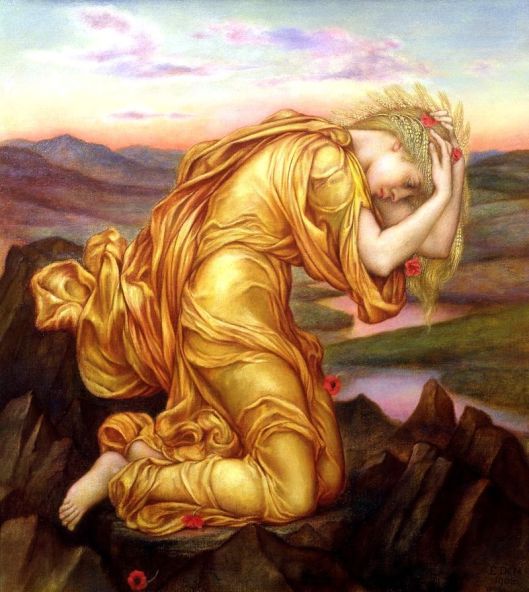
Also known as Ceres: ‘Demeter Mourning for Persephone’ 1906 By Evelyn de Morgan {{PD}}

I was wondering if the spate of attention I’m giving Ceres (or Ceres is drawing me toward!) warranted a little investigation. The current picture is this: Ceres is in apparent retro motion in Leo, in close quincunx to Juno in Pisces–and Juno is sextile Saturn in Capricorn, within range of a quincunx to Ceres, so making Ceres apex to a Finger of God. Why does it seem Ceres is so often involved in a Finger? Maybe that’s about Ceres as a natural expression of the flow of energy, with the influences exerted by Nature and our own expressions of Ceres (Nature, agriculture, the power of authority, negotiation, food sensitivities and allergic reaction, to name just a few) ways of dealing with and responding to the extant energy stream (and so to power, and to its consequences) in the world.

This particular Finger implies that empowerment through dreams, visions, creativity, or the loss of this through deception or misunderstanding couples with the reality picture to result in a personal (Leo) experience of the extents of our authority, our body’s ability to process food and/ or the environment, of our role in nurturing or guiding another (a maternal role), and/ or in a need to negotiate in order to see our dream or project realized, or our authority (perhaps even our autonomy) returned. Ceres is also widely sesquiquadrate Vesta, pinpointing the home environment and something to be learned there (Sagittarius placement) that can help further or restore our empowerment options.

And here’s a re-post from the blog: What You’re Asking: Ceres and the Death of Shelley, Synchronicities, and Rejecting a Gemini Man

What does Ceres have to do with health?

In mythology Ceres’ Greek predecessor, Demeter, was goddess of Nature, abundance, and the fruits of the Earth, but by the time she reached Rome and her current name and form, she was decidedly more tame: a goddess of agriculture, of Nature that’s been shaped and subjugated to man. That suggests that in modern conception she may deal with the balance of the body and its vulnerabilities to natural elements, of being overwhelmed from without (drowning, buried in a landslide, struck by lightning, for instance, or from things like allergens and starvation) and from within by invasion (of germs, viruses, bacteria, fungi). She doesn’t offer a total picture of health in the natal scenario or by transit, but does speak of certain conditions one may be prone to, or illnesses susceptible to, aside from her other meanings: a sense of personal power and authority, a maternal interest in others (which can easily tip into a controlling one), territoriality, and negotiation.

Romantic poet Percy Shelley (4 August 1792 10 PM Horsham England) was just coming up on a Lunar Return in Pisces the day he drowned in a boating accident (8 July 1822 Lerici Italy). He has Ceres natally conjoined the Sun, Venus, Pallas, and Uranus in Leo in the Whole Sign 4th (and though Juno’s close enough to the Sun, it’s too wide for Ceres, in my opinion); Ceres is also opposed Pluto and quincunx the natal Moon and Sedna in Pisces. Already we can see that Ceres was a vital part of the life, and so of the death as well. In the context of the drowning event, the natal scenario suggests sudden accidents (Uranus) based on unwise decisions (Pallas–staying on the water despite the storm) activated the Self-destruction he had always been conscious of, and perhaps at times had to fight (Sun opp Pluto), with Ceres’ involvement implicating the elements, the weather, even potentially activating an emotional attachment to the water, and a need to adjust (the quincunx) to prevent getting lost in it! (the Pisces Moon)

The Cremation of Percy Bysshe Shelley, by Louis Édouard Fournier

The Cremation of Percy Bysshe Shelley, by Louis Édouard Fournier

On the day he died, Shelley’s Ceres was contacted exact by degree by the transiting South Node, suggesting a ‘pull back’ to a previous (pre-birth?) state; t Ceres was opposed natal Mercury in the 5th=the elements literally in opposition to the lung function; t Merc was conjoined n Chiron in Cancer in the 3rd of lungs, breathe=water water everywhere, water that injures; t Mars was conjoined the n NN, spurring actions and choices that take one into the future; and t Earth sextiled the n Moon-Sedna, forming the base of a Finger of God with apex n Ceres-Pallas=here’s a recipe for the environment ganging up with instincts and emotions to prompt that natal judgment of Nature. Shelley may have believed he was very practical (Pallas) in his relationship to the elements and the natural world (Ceres), feeling that instinct (Sedna) and emotion (the Moon) would inform his choices. There’s a sense that he didn’t fear them, that instead the Pisces Sedna-Moon may have seen the obliteration threat of the natal Pluto opposition as a kind of Oneness with Nature–absorption rather than obliteration. Too, the transiting Sun had just run over his natal Black Moon Lilith=he may have been more than a little in the mood to explore the darkness.

To A Star

Sweet star, which gleaming o’er the darksome scene
Through fleecy clouds of silvery radiance fliest,
Spanglet of light on evening’s shadowy veil,
Which shrouds the day-beam from the waveless lake,
Lighting the hour of sacred love; more sweet
Than the expiring morn-star’s paly fires:–
Sweet star! When wearied Nature sinks to sleep,
And all is hushed,–all, save the voice of Love,
Whose broken murmurings swell the balmy blast
Of soft Favonius, which at intervals
Sighs in the ear of stillness, art thou aught but
Lulling the slaves of interest to repose
With that mild, pitying gaze? Oh, I would look
In thy dear beam till every bond of sense
Became enamoured–  

That was definitely written by a guy with Sun-Venus-Ceres-Pallas-Uranus conjoined, all opposed by Pluto!

Synchronicities

Synchronicities have been everywhere lately–have you noticed that for you, too? Those little mentions or phrases or events or people that grab your attention simply by the unlikely way they’re brought into one’s compass repeatedly within a short period. To my mind that signals we’re in a kind of flow, that attunement to the optimum vibrational level for you is very close to perfect–and that implies intuition is sharp and accessible, that information is yours to pluck right out of the air, that you can ‘know’ without anyone telling you. Though our tendency is to breeze through these interludes, to remark ‘Isn’t that strange?’ when we hear the same song or its lyrics or mention of the singer in every store and elevator and TV show and conversation we’re exposed to the entire weekend, and at the same time to be very focused consciously on the here-and-now, what we really need to do is pause; this is a point when we are cruising along with a lot of our perceptual abilities working below the surface, and we can see the world very clearly, if we are willing to. We can get our questions answered, if we’ll only stop looking out, and take a moment to look within.

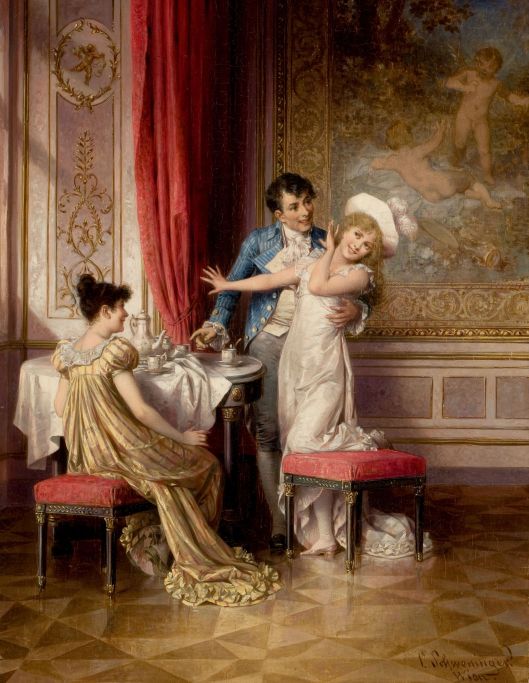
Carl Schweninger the Younger 'Not Willing' 19th century {{PD}}

Carl Schweninger the Younger ‘Not Willing’ 19th century {{PD}}

rejecting a Gemini man

Are you thinking there’s some magic word (he’s a Gemini, after all) that will make him take it well, not make a fuss, even see it as a gift? There’s not, and it’s likely that if he senses you are trying to out think him (by manipulating or being one step ahead, the latter of which you automatically are if you know something–that you intend to reject him–that he doesn’t) he’ll be very resentful, indeed. Geminis are highly focused on thinking, processing info, communicating, networking–so he may already be aware, whether it’s through the grapevine or through reading your body language and tone in previous encounters, that you aren’t interested. That puts you in a precarious position: if he does know and he’s still coming at you, he’s forcing you to say it outright, and if he doesn’t know, he’s going to feel especially upset that he didn’t parse it out ahead of time (it’s a Gemini thing–they always think they should’ve known!) All you can do, really, is send a clear, consistent, and polite message through every pore of your Being and, obviously, word spoken: no thank you. Problems will only arise if you’ve been ambivalent in your feelings or in your behavior, wrongly believing that will ‘let him down easy’ (and if so I bet you’re horoscope is chock full o’ Water signs). Come clean without engaging in any way that sends the wrong (that is, an enmeshed behavioral or contradictory) message, and it should go fine–the last thing you want to do, and he wants to feel you’ve done, is mislead him.

I hope you’re having a great week!

Viewing the Ascendant in the Whole Sign Chart

Tags

, ,

The figure in the lower left corner is a great symbolic representation of the Ascendant point of the chart. By an unknown artist. First appeared in Camille Flammarion’s ‘L’atmosphère: météorologie populaire’ 1888 {{PD}}

This is a re-print from an issue of ECLIPSE, with some new material added.

Using the Placidus House system over many years, I came to truly love the Ascendant of a chart; for the individual it’s a declaration, ‘Here I am, and this is who I am!’ literally representing the moment the person arrived in the world, and describing the attitude, the ‘face’ with which they meet everything they encounter. For an event it describes the moment of inception, the event’s first thrust into reality, and for both an individual and an occurrence, the Ascendant describes the character of what’s presented to the observer. This point in the chart both tells us of the initiating nature of the individual or event, and tells us what was on the horizon at the time and place of this ‘birth’. The integration of the point itself into the other points and bodies of the natal chart (by aspect) tells us the story of this entry point, and the character of the first House tells us what outlook supports this personality.

With the Whole Sign system, we see the Ascendant relocated, in a sense, to a point within the 1st; it no longer demarcates the chart in a definitive way, acting as ‘the place where everything begins’, but instead becomes a part of the 1st House itself, with the implication being that the environment of the 1st House determines Ascendant expression. By that I mean, the Ascendant is essentially a reaction to the environment into which one is born; as such, it describes survival skills the entity developed to cope with the early (immediate) environment. It’s a statement of what the individual believes they must do or produce in order to survive—and so can be highly revealing of core beliefs and assumptions about the world, as well as indicative of the individual’s likely natural, initial, instinctive response to pressure/ stress. This is in contrast to the approach in the Placidus system, where we may see the Ascendant nature as a fait accompli at birth, due to its prominence on the horizon of the flat chart. With Whole Signs, we allow for the shaping of reactions and personality, unlike with Placidus, which symbolically fixes the personality to the horizon, to birth, to the moment of entrance, and so imbues the Ascendant with an aura more fatalistic than expressive.

The Ascendant could also be viewed as the individual’s own personal Aries Point, if we define the Aries Point as the place at which the Sun enters 0 degrees of a Cardinal sign, which corresponds with the start of a new season. The moment of birth could be seen to represent the start of a personal new season for the individual. A new life brings a new outlook, and incarnation the translation of the unseen into physical form (that is, the spirit into a human body). We can’t discount what that individual may be bringing with them, consciousness that exists beyond the timeline that begins with the moment of birth, which argues for the Whole Sign system, with the symbolism of the Ascendant placed within the 1st rather than acting as the cusp of it, so that some of that 1st House ‘essence’ is placed above the horizon, symbolizing that non-material state of the spirit prior to translation into human form.

The flexibility offered by the Whole Sign system in relation to the Ascendant, represented by the way the ASC is found somewhere within the 1st House, means that we get a more holistic view of the personality; it presents not as an assertion of personality, a statement of ‘I Am’, as much as an ever evolving viewpoint that rises naturally from interaction with the environment. This means that we are inclined in interpretation to see the personality quirks and difficulties that arise from it not so much as irrefutable facts, but as responses—and seeing things that way offers us the opportunity of modification and change in the moment and in any direction, rather than the linear Placidus model that suggests only a single line of possible development, with much less suggestion of dimensionality.

If you’re still unclear about what I mean, draw on a piece of paper just your 1st House, once with the Ascendant on the cusp (the Placidus model) and then again with the Ascendant sign from 00 to 30 as the 1st House, with the Ascendant placed inside (the Whole Sign model), and see if this doesn’t convey two truly differing impressions of the Ascendant and its possible readings. Both are useful ways of looking at the chart, and both tell a story about who we are.

A Little Change

By Unknown – vQEPnXLblnBFYQ at Google Cultural Institute, zoom level maximum, Public Domain, https://commons.wikimedia.org/w/index.php?curid=29675767

Change is a good thing, right? Unfortunately there are only so many hours in a day, so for a while I’m going to be skipping daily forecast posts, in favor of short articles, commentary, and re-posts of greatest hits or interesting topics. I’ve been neglecting broader subjects out of the need to do that everyday thing, so would like to shake things up just a bit. I hope you’ll continue to drop by and keep in touch; I’ll be popping back later today with a little something.

Just a Little AstroEssence 28 February 2018 Into the Full Moon

Tags

, ,

Japan, 1878, 12th month, Series: Allusions to the Seven Planets By Tsukioka Yoshitoshi {{PD}}

On the 28th it’s all about communications, thinking and reasoning, ideas, and sudden changeability, the quicksilver reactions of a mind that shifts before we can consciously address what’s happening. And what are we thinking about, talking about, and maybe changing our minds over? The power situation, and our dissatisfaction with it (Mercury sesq Ceres), angry episodes, our own anger or that of others (Mercury sq Mars), clever ways to change the situation (Mercury sxt Pluto), what we truly care about, and how that’s not being honored (Mercury sq Vesta), and the difficulties we have reaching for what we desire or getting what we aim for (Mercury qnx Zeus). This is our lead-in to the Lunar event for Wednesday.

On Thursday we see a pre-Full Moon atmosphere centered on one of two areas for each of us: one group will be appreciative, seeing assets or rewards expand, the mentality steeped in Love, actively living some version of the ideal Self (Mercury parallel Venus, Venus trine Jupiter, Sun parallel Neptune); the other sees a need to address the power situation or the distribution of authority actively, maybe angrily (Sun parallel Juno, Mars sesq Ceres). And then, the Full Moon–

Full Moon in Virgo March 2018 Seeing Inside the Machine

Tags

, , , , ,

Charles Hoguet ‘By the Windmill’ 1870 {{PD}}

The Full Moon occurs at 4:50 PM PST March 1st at 11 Virgo 22. A Virgo Full Moon promises we’ll get the details, that we’ll receive an accounting, that the means of production (to borrow an old, reddish phrase) will be clear, and all of it allows us to make critical decisions, to apply a discerning eye to what culminates, concludes, or reaches a ‘full’ point of assessment, creating a need to be judged so that the next step can be taken, or at least mulled over. With a FM in Virgo, we see inside the machine–but the Moon is central to what happens, so does the machine see inside us as well, via our emotions or an intuitive exchange of information or ideas? Yes, it does, and this allows the machine to read us, to shape what it creates according to our spiritual orientation, our imaginings, our ideals, our beliefs.

The machine, of course, is the Universe, but we’re unlikely to recognize it as such. The FM opposition to Neptune (meaning the Sun and Neptune are conjoined, perfecting two days or so post-FM) suggests we look out from our emotional or intuitive ‘read’ of the Full Moon experience and we see whatever it is we want to see–or at least, what we see takes a form that is meaningful to us–as this may appear to be an accident, a shock or surprise, or something foisted on us by the group, a modern concept or convention that we are required to follow, if we don’t want to be left behind, if we want to remain a part of the Collective (Sun-Neptune in Pisces, FM sesquiquadrate Uranus). For those focused on the Virgoan energy, this may present a time machine, of sorts, where a review of the past shows how we got to the present, and in certain ways offers a ‘do-over’; for those focused on the opposing Piscean energy, this may present a timeless machine, losing the particularity of the Full Moon within the larger Cosmos, a kind of ‘seeing and realizing All at once’ experience.

The FM also trines the Black Moon Lilith point, and with generous orbs we could call this an Earth Grand Trine with Pallas; this points us toward the nature of the material effect we might get from the FM event. It suggests that what we’ve ignored, denied, or been enraged over (BML) is a factor in what culminates at the Full Moon, and that ultimately this delivers a balanced material result that is wise, practical, or both (Pallas). What we see in material terms is a response; what we’ve done, or not done, is made apparent, and in some form, judged.

Gertrude Käsebier ‘The Bride’ 1901 {{PD}}

The Sabian for the Full Moon is, ‘After The Wedding, The Groom Snatches The Veil Away From His Bride’. It’s the ‘Big Reveal’; what did our past efforts bring us? And immediately our critical faculties kick in, assessing what we’ve got. Maybe pleasing, maybe not, but we must consider that perhaps the very act of judgment isn’t pretty, either, and perhaps beside the point, as the action’s already complete.

We also look at the Sun for a Full Moon. ‘In The Sanctuary Of An Occult Brotherhood, Newly Initiated Members Are Being Examined And Their Character Tested’. Maybe this Moon is a kind of lesson, one that reminds us our sanctuary is found within the machine, not in some rarefied and separated corner of the Universe. Certainly, how we respond to what we’re presented with will say a great deal about character and attitude. Sometimes it’s hard to remember that it’s all a spiritual experience; the material and physical can overwhelm us through the senses, driving out consciousness of the spiritual underpinnings beneath. So, the Full Moon becomes a point of personal reckoning, a statement about our relationship to All-That-Is, on top of any worldly results gleaned.

Support the blog through donations (a dollar or two per month recurring is super-groovy), through reviews or ratings at GoodReads or on my facebook page, or through purchasing my books, currently only available here–wishing all an enlightening Full Moon experience, and sending much gratitude–Thank You, Readers!


Just a Little AstroEssence 27 February 2018 Seductive Uncertainty

Tags

, , ,

Vertumnus and Pomona‘ By David Teniers the Elder 1637 {{PD}}

The ideal-focused among us (or I should say, those of us who believe perfection is possible), and those who are susceptible to Self-doubt, may think we must modify our own innate authority and power in order to receive Love–but if it’s really Love, it doesn’t ask us to change, does it? That’s what makes the current Venus sextile to Pluto and sesquiquadrate to Ceres so confusing: Love beckons and says, ‘Let’s transform this!’ and we hear an unspoken, ‘to a higher level’, but we are ignoring all the danger inherent in looking too closely at Love, too sharply into the abyss, and simultaneously find ourselves aware that this love-thing is making us very uncomfortable with our personal authority and power, as if our agency is costing us Love–but as we know, real Love doesn’t require us to curb our power or expression. So what is happening? We’re focused on making ‘it’ happen, on ambition fulfillment (Mars sextile Zeus) and we’re already struggling with trusting ourselves and our instincts–we are perhaps too conscious of our potential for falling into a ‘blind spot’ (Juno contra-parallel Sedna)–and then along comes that seductive Venus and the compelling nature of the darkness, the mystery and compulsion of sex, the heady energy of Power, and it’s promised as some material or tangible thing (Pluto in Capricorn)–and we may feel that our life direction is unwise or impractical, that in making our choices, we’re missing something (Pallas square the Nodes), and this uncertainty weighs on us. So what it’s really all about is confidence in who we are, in our ability to make choices, to handle what comes at us–so today becomes a Rorschach test of how surely we believe we can handle anything we meet. Hint: if you find yourself facing a lot of Self-doubt today, you need to ask why you don’t trust yourself to ‘have your back’, as it were.

Today’s word image is a sign along the road that reads, ‘Half Way’–but how can we know we’re ‘half way’ unless we know both where we started and where we’re going? Maybe this is a reminder not to think we know more about our own Path than we actually do.

Just a Little AstroEssence 26 February 2018 Purging the Green-Eyed Monster

Tags

, , ,

Juno’s bird, sometimes associated with envy. Pieter Boel ‘Study of Three Peacocks’ c1670 {{PD}}

We see a lot of internal harmony, strength, inventiveness, originality, and spontaneity–unless we’re being affected by jealousy, envy, or greed. Find out what, if anything, might be stopping up the flow of creative positivity, and once it’s gone–full speed ahead! (Mercury nov Uranus, Venus quincunx and Juno parallel Zeus)

Today’s word image is two birds on the ground, one in flight. What has recently ‘taken off’? Are you distracted by what didn’t ‘take off’? Can you keep up, or is this an instance of something ‘flying the coop’, and so out of your hands? Are you noticing sets of three? With the latter, this image might be less about achieving lift-off of one kind or another, and more about the synchronicities that noticing threes will prompt attention to.

Your Weekend 25 February 2018 Sacred Aggression

Tags

, , , ,

Chinese sculpture dating from 960 A.D. Photo by James Tourtellotte {{PD}}

Though to some of us this may sound like the concept carries an inherent contradiction (it doesn’t–I’ll explain in a second), sacred aggression may be the stance initially taken as Mars conjoins Vesta in Sagittarius, even as a close square of these from Venus ups the conflict ante. Now to the supposed contradiction: we may mistakenly see something sacred as automatically implying something peaceful–but if we make that association, we need to realize that it’s not a given; in reality, we aggress and defend almost exclusively over sacred territory. It may not seem like anything serious when Jane is angry over a stranger’s remark about her parenting skills, but if Jane carries the idea internally that she is a conscientious and dedicated mother, then that role is likely something she sees as sacred to her Self-concept, and so something to aggress in defense of. Likewise, criticism of Joe’s choice may make him (seemingly unreasonably) angry, but if his concept of ‘being a man’ includes the idea that his choices are inherently the best choices, then his disproportional response may be in defense of a core (and so sacred) Self-concept. Today we may see most everyone engage in this. We may fight for what we believe in, for what we honor and find sacred, and for what the ego wants to see as sacred; we are vetting the facts and our own beliefs, defending what is even as we explore what may be, and this is especially so in relationships and/ or finances, where the potential to learn more (Sagittarius) opens up not just conflict (the square) but possibly change, as well (Sun sextile Saturn, fixing our attention on reality, its parameters and barriers).

We have another major factor at work here: Mercury is conjoined and parallel Neptune, suggesting the mind is focused on the ideal in many forms: the spiritual, the creative, the Oneness of All, on potentials glimpsed in dreams and fantasies–but with the possibility of thoughts and perceptions being overwhelmed by the deceptive, the confusing, the nebulous, the draining. So, it may be that the alignment of our mentality with high ideals and purposes may help keep our quest to defend and honor the sacred on its best track, serving its most evolved forms, and so allowing a kind of ‘Sacred Warrior’ stance that brings forward the highest expression of the individual.

We also see Mercury quincunx the North Node, sextile Pallas, and contra-parallel Sedna. That’s mostly good news, implying the mind will be keyed to wisdom (Pallas) and capable of keeping the future in mind (and so making choices that are beneficial–NN), with the only upset possible through one of two things: a rejection of the illumination switched on and unafflicted instincts can offer, or through allowing ‘blind spot’ material to seep into the thought arena, and so contaminate what we believe is pure. Not an easy day, but a tremendously important one, in terms of Self-understanding and expression of commitments, and offering a crisp gut-check on our own alignment with reality.

‘The Old Ships Draw to Home Again’ Jonas Lie c1920 {{PD}}

Today’s word image is getting to the dock too late–your boat has sailed. Well that’s obvious, right? What have you ‘missed the boat’ on? Was it recent, or a long time ago, and do you still regret it? Why? I have two thoughts here: one is that the Universe always works in our favor (though we may not be able to see that at the time), so there’s nothing to regret. Second, did ‘missing the boat’ spur you to do things differently, to change your behavior, or did it stop you from pursuing anything of this ilk again? What arose from ‘missing the boat’ is even more important than the lost opportunity/ event–which is why you should endeavor to look at what it generated in you.

Julie Demboski's ASTROLOGY

Addressing the Individual Experience Within the Universal Truth

Skip to content ↓